Showing posts with label Balkans. Show all posts

5 February 2014

In the Balkans with bicycle and public transportation: a guide for the cycle traveller

2023 update: almost 10 years have passed since this post was written. Unfortunately most links are broken and the information is generally no longer reliable. Sorry!

This little guide wants to be a help for all the cycle travellers who are interested in visiting the Balkan countries, perhaps using public transportation for some parts of their journey. It's based on my personal experience (October-December 2013) and on information found in the Internet.

To search for trains, I suggest starting from a map of European railways and from Deutsche Bahn's search engine (which however does not include all countries).

Ferries connect Italy (Ancona, Bari, Brindisi) with Zadar, Split, Dubrovnik, Bar, Durres, Vlore, Igoumenitsa, Kerkira, Patras.

Here are the most relevant pieces of information, divided by country:


SLOVENIA

Bicycles are admitted on all the main lines that go from Ljubljana to Koper, Maribor and Jesenice/Bled. The additional fare is 3,20 €, no matter the distance you are going to travel.

Currently there are no trains that connect Italy to Slovenia. From Trieste you must cross the border with bicycle/bus to reach Sežana or Koper.


CROATIA

There are local trains and Intercity trains (not high-speed though). Usually Intercity trains connect Zagreb to the other main cities and some of them allow to transport bicycles (you can verify which ones offer this service on the official schedules at the train stations, anyway there is at least 1 train per day on every line). New trains, both regional and IC, have a big space for bicycles.
The additional ticket doesn't have a fixed price: it costs 30 kuna for the IC Split-Ogulin (7-hour travel), 41 kuna for Ogulin-Rijeka (regional, 2.5 hours).


Regional train Ogulin-Rijeka with compartment for bicycles

Buses are also commonly used: from what I could find on the web, however, bicycles are only allowed if they are approved by the driver, based on the season and on the available space in the luggage storage.


HUNGARY

The Hungarian railroad network is quite extended and regional trains also reach many very small villages. Bicycles can be carried in the dedicated space or in the head/back of the train, paying a ticket that costs 25% of the normal price for 1 person.

Budapest is also connected with international trains to Wien, Ljubljana, Prague, Belgrade and Berlin.


SERBIA

Serbian railway service is not so good. The majority of the national trains (not many, to be honest) run on the north-south line Subotica – Novi Sad – Belgrade – Niš. Almost all of them admit bicycles, but actually there's no storage space: you will probably have to stay in the very narrow aisle near the entrance doors and move the bicycle at every station to allow people to get on and off.
Prices are very low: a one-way ticket Novi Sad – Belgrade costs 300 dinars (less than 3 €), with a 100-dinar additional fare for the bike.

International trains leave daily from Belgrade to Zagreb, Budapest, Bar, Skopje and Sofia (1 or 2 every day). The journey Belgrade – Sofia takes 10 hours (at the average speed of 50 km/h) and includes a stop at the Serbian-Bulgarian border (where the Police searches for smugglers). The ticket costs about 20 € and there is no additional cost for the bike.
Just be aware of the fact that I was travelling during low season, when trains were not full. If you travel in the summer, things might be different! Always check in advance if your bicycle is admitted.


BULGARIA

Bicycles can be carried on all trains paying 2 lev (1 €), both on the modern trains (where there are more empty spaces for bicycles) and on the old ones (similar to the Serbian trains, with narrow doors and steep stairs). Normal train tickets are quite cheap in Bulgaria as well.


GREECE

Due to the mountains that occupy most of the mainland, Greek railway network is limited to the main lines Athens – Thessaloniki e Athens – Korinthos, with a few additional secondary lines. On Athens – Thessaloniki high-speed trains bicycles are admitted only if dismounted and closed in bike bags, like in Italian high-speed trains. In the other lines they can be carried without paying additional fees.
However, be aware that there are no “low-speed” trains that connect Athens with Northern Greece. Also, regions like Epirus don't have railways.

The most common public transport mode is the bus, in which bicycles are admitted without additional tickets if there is space in the luggage storage. Personally, I used the bus to go from Delphi to Athens and I was recommended to take the first bus at 7.30 am to avoid the more crowded ones.


ALBANIA

The railway network is almost abandoned and the most popular mean of transportation is the bus. There are “official companies” that offer services with fixed schedules (even if “schedule” is a big word!), and there are also the famous furgons (10-15 seats) that wait at the side of the road until they collect enough people who want to go to the proposed destination. Obviously bicycles can only be carried on the big coaches. The cost of the ticket is ridiculous: for example, the route Saranda – Tirana (via Gjirokastër, Fier, Durres, about 400 km in 6 hours) costs 1300 lek (9 €) + 300 lek (2 €) for the bike. Shkodër – Tirana: 300 + 300 lek.

In Albanian cities there are not real bus stations: different lines can start/arrive in different places, which often are not indicated, so you must find out in advance where is the waiting place for the bus you are interested in. Anyway, even if there's not a German-like organization, the atmosphere of a bus trip through Albania is something unique!
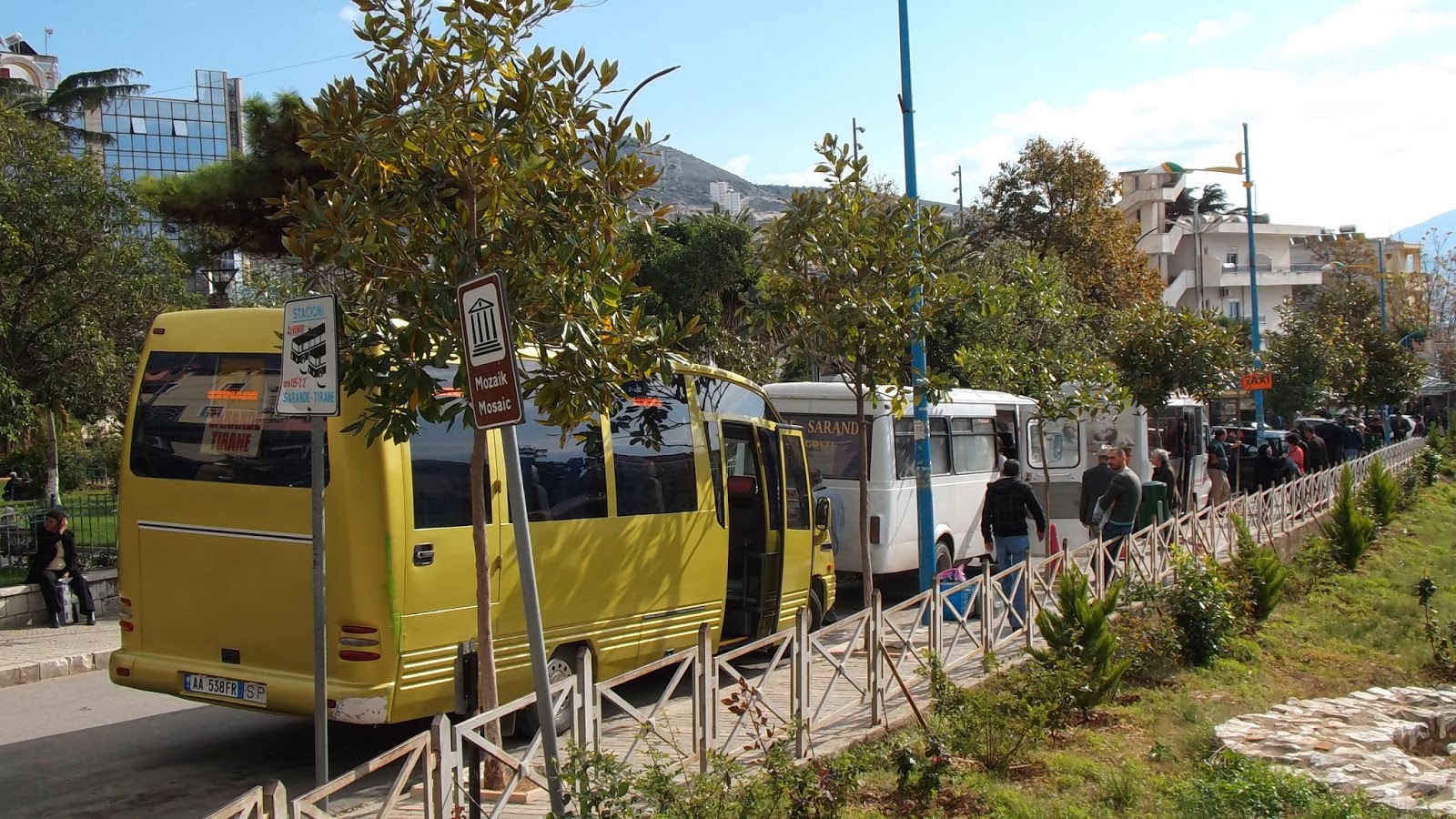

Buses and furgons waiting to leave from Saranda

Finally, because of the huge number of Albanians who live in Greece, many bus lines connect Albanian cities to Athens, Thessaloniki, Volos, Patras and other Greek cities daily. Bicycles are admitted on these buses, as experienced by a couple of cycle travellers I met on the road.


MONTENEGRO

The website lists all the daily local and international trains that travel across this tiny country.
The line Bar – Belgrade, which takes about 8 hours, is described as one of the most panoramic European railways, especially in the Montenegrin stretch that runs along Lake Skadar and then crosses the Dinaric Alps.

Buses connect the towns along the coast with each other and with the major cities in the surroundings (Dubrovnik, Mostar, Sarajevo).


BOSNIA AND HERZEGOVINA

The website lists all the local and international trains that travel across Bosnia-Herzegovina. Sarajevo is connected to Zagreb (via Banja Luka) and to Ploče, on the Adriatic Sea (via Mostar). The ticket for the train Sarajevo – Mostar (very beautiful mountainous landscapes) costs 9,90 Bosnian marks (5 €) and the additional fare for the bike costs 7 KM (3,50 €).


Sarajevo – Mostar on a Swedish train of the 1960s...
Very comfortable seats and huge space for the legs!


Countries I didn't consider in this guide: Macedonia and Kosovo.

Overall, when coming to plan a bike journey through the Balkans, the option of combining biking with public transportation should be considered: this choice can allow you to visit more places and/or skip some climbs, travelling cheap and in a sustainable way.

Even though the cycling infrastructures cannot be compared to Central Europe, the Balkans have much to offer to those who wish to explore this region, admire its naturalistic beauty and know more about the history and the culture of its peoples.

9 December 2013

Borders

"Mitakuye Oyasin" is a Lakota prayer. It means "we are all related" or "all my connections".
We are all related, so there is no difference among people, so need for borders. "Imagine there's no country...", using more famous words. I don't know if it is just a coincidence, but I immediately thought at where the Lakota people live: in the never-ending Great Plains. How can you imagine setting a border in a place like that?

64 days travelling through the Balkans, 18 borders crossed:
1) Italy-Slovenia
2) Slovenia-Croatia
3) Croatia-Hungary
4) Hungary-Croatia
5) Croatia-Serbia
6) Serbia-Bulgaria
7) Bulgaria-Greece
8) Greece-Macedonia
9) Macedonia-Greece
10) Greece-Albania
11) Albania-Montenegro
12) Montenegro-Croatia
13) Croatia-Bosnia and Herzegovina
14) Bosnia and Herzegovina-Croatia
15) Croatia-Bosnia and Herzegovina
16) Bosnia and Herzegovina-Croatia
17) Croatia-Slovenia
18) Slovenia-Italy


Many people asked me how it is to cross a border on a bicycle. The answer is: nothing special. The first time is fun, then it becomes just a matter of showing your ID (Italian citizens don't need passport for any country that I visited, even for those that don't belong to the EU) twice to the Police of both countries on the border. They might ask you where you are going, and nothing more.

A lot of blood was spilled to determine whether a certain border should be in the place it is or a few kilometres away. Borders changed the lives of many people: am I part of a majority or minority? Was I born in the "wrong" place? Lakota people would not understand this, I bet.

Questions:
1) Why do borders exist?
2) Are borders immutable?

While borders have a certain political and administrative function, I think it is everybody's task to question their existence, at least on a "thesis, antithesis, synthesis" base. Thinking that the current borders have always existed, have historical legitimacy and therefore will always exist is just useful propaganda, most of the times. In fact, borders don't exist, if you try to convince yourself of it.

It seems common to all countries to declare their current borders immutable to prevent parts of their territory to secede and declare independence. For example, Article 5 of the Italian Constitution states: "The Republic, one and indivisible, [...]". The United States of America also don't give the right to secede peacefully to parts of its territory, although the 1776 Declaration of Independence would suggest the opposite, when saying that "[...] whenever any Form of Government becomes destructive of these ends, it is the Right of the People to alter or to abolish it, and to institute new Government, laying its foundation on such principles and organizing its powers in such form, as to them shall seem most likely to effect their Safety and Happiness".

Without aiming at writing a political essay, I just wanted to introduce the topic because I feel that there is too much nationalist crap everywhere in the Balkans (and not only there...). I'm saying it straight just because I started loving the history, the culture and the people who live in this area, and when you love a place you try to understand its past and care about its future.

For nationalists, borders separate "us" from "them". Even though those borders changed several times in the past 100 years, now they can't change anymore, they say. Tradition, culture and language of the homeland must be preserved, apparently.

But seriously, how can people (not politicians, who do it just for their own interest) give so much importance to these fictitious lines?
Any Serb will find happiness when the last Bosniak leaves Republika Srpska?
Any Croatian will find happiness when Vukovar becomes a cyrillic-free city?

Mitakuye oyasin.

22 October 2013

Biking through recent History

I had read some things about the Yugoslav Wars before the begin of this trip. After seeing the places with my eyes and hearing stories from people who were actually there in the years of the war, I'll try to write a few impressions about this topic with regard to Croatia and Serbia. If the journey goes as planned, I might visit Bosnian cities of Mostar and Sarajevo on my way back.

(It's not an "easy" topic, so any comment/correction is welcome, as always)

  • Vukovar:
    I must start from here. This city is the symbol of the Serbian-Croatian war. I've been told that it was one of the richest city in former Yugoslavia. You might agree that it's true just by looking at the many big factories and industrial buildings that you see if you arrive in the city from the west.
    Then, the war. The population, which was evenly distributed between Serbs and Croats (who had lived together peacefully until then), has dropped from 45.000 to 25.000: many Serbs moved to Novi Sad or Belgrade, many Croatians started a new life in Zagreb, far from bullet-marked houses, mined fields and an atmosphere which is still filled with hate and contrasts between the two ethnical groups. For example, Serb and Croatian kids are in separated classes at school until college. The events of the past are still too recent to be forgotten, the difference is about how people look at them: someone remembers and looks at the future, many other people remember with their heads turned back to the past.

  • Breaking news: my part in the history of Vukovar :)
    I arrived in Vukovar on October 17. On the same day the Prime Minister of Croatia, Mr. Zoran Milanovic, was in the city to talk to the nationalists and to the war veterans about the issue of cyrillic signs, which are to be installed because the Serb minority make up more than 1/3 of the total population of the city. High tension. In the previous days, 2-3 policemen of the special forces had to stand in front of every plaque written in cyrillic alphabet, because of people continuously trying to tear them down (big question: why?). So... this guy (me) who arrives on the bike seems an alien in this place at this time: is he a terrorist who hides a bunch of AK-47 in his panniers and aims at killing the PM? I don't know if they followed me or what, the fact is that the Police called Zoran, my Warmshowers host for the night, to make sure I was actually a normal traveller...
    Weird story, but it exemplifies well how the situation is around there.


  • My meetings
    A girl whose family escaped from the Croatian part of Baranya because of the war and then returned when it was over. A professor in Vukovar High School who was studying in Novi Sad during the war, having his family in the middle of the conflict. Now the big old house of some of his dead relatives has almost no value, since the city is still under reconstruction and has high unemployment and very little perspectives for the next future.

  • Yugoslavia and Tito: a compendium (trying to simplify complicated things)
    - Yugoslavia as known between 1945-1991 had never been a unique country in history, although some cultural traits are common to the people of the area. Parts of its territory were controlled until WW1 by Austria-Hungary and Ottoman Empire.
    - Croatians are mainly Catholic, Serbs are mainly Orthodox. In Bosnia and Kosovo there are big percentages of Muslims as well.
    - 1941-1945: Yugoslavia is occupied by the Nazis and other Axis countries. In Croatia there is a satellite fascist government (Ustaša), responsible for killing many Serbs.
    - 1945: Partisans led by Tito send away the occupants. It's the only European country which is not freed by the Allies, thus allowing it to take a Non-Aligned position and a certain independence from the Soviet block in the Cold War. Yugoslavia is organized as a federation, in which the regions are more or less those that now have become independent countries.
    - 1970s: Despite economic difficulties and rising requests for more independence from what has always been considered a Serb-centric nation (see Great Serbia), the country remains in peace until Tito's death in 1980. Tito was a dictator, but he represented at the eyes of most of the population a positive hero and a common symbol of anti-fascism.
    - 1980s: Changed economic balance in Europe (due to USSR's collapse), loosened grip of central government on peripherical regions, contemporary growth of nationalisms in Slovenia, Croatia and Kosovo.
    - 1990s: Breakup of Yugoslavian Communist Party. Referendum on independence in Slovenia, Macedonia, Croatia, Bosnia. The former 2 states obtain independence "easily", Croatia and Bosnia fight for it until 1995, when NATO intervention put an end to the conflict.
    In 1999 other NATO intervention in support of Kosovo Albanians against Serbia.
    - 2000s: Montenegro and Kosovo form independent states.

  • Consequences of the above:
    - Presence of nostalgia of Tito.
    - Serbians feel "victims" of US and Western European interests in the area (mainly regarding Kosovo, which they don't recognize as a country): good reason to "use" to raise Serbian pride, nationalism, etc.
    - Relationships among countries and among different ethnic groups in the same country are far from being stable (excluding Slovenia).
    - These problems stop Serbia from entering the EU. Macedonia has quarrels with Greece and Bulgaria as well.

  • As said by a disilluded Serbian guy at the hostel in Belgrade:
    "There are 2 political parties: one of them is the party of the football hooligans (of every team) and of the nationalist idiots, which are often the same thing; the other one is the party of the people with a little bit of brain, but it's mostly made up by idiots anyway."

22 August 2013

Preparing the journey: the Balkans [EN] [IT]

40-50 days to go, but the preparation for the journey is still way behind the schedule (not even sure if a schedule exists).
I'm planning to go east first, then south. Slovenia, Croatia, southern Hungary, Serbia, western Romania and Bulgaria, Greece. Then back north towards Macedonia (somebody would prefer FYROM), Albania, Montenegro, Bosnia and Herzegovina, Croatia and Slovenia.

Balkans. A part of Europe which is often looked at with suspicion and judged by stereotypes about its peoples and its recent history. It may be true that some of these little countries recently born again from the ashes of Yugoslavia are far from being important in a political and economical vision of Europe. But it's also true that this area has an astonishing past and a multicultural identity that was unique in Europe until the very recent past.

Travelling might be a lot about looking around, taking pictures, visiting monuments, having fun. And, at the end of the trip, crossing a name from the "Places I have to see" list and look for the next destination. Yet, I believe this is not enough to make a good journey. Travelling is also like studying. If there was a University course in "Travelling", I would imagine it to be a hell of a difficult degree. And, since I'm putting a big effort on this project and I consider it my job for the upcoming year, I believe that reading, studying and finding information on the places I'll visit is the key to look at things with a different spirit and to be able to be a travelling storyteller once on the road.

Right now I'm reading a great history book: The Balkans: Nationalism, War & the Great Powers, 1804-1999, written by Misha Glenny. About 600 pages about the last two centuries in the Balkans, from the time when the peninsula was completely occupied by the Ottoman Empire to the recent wars in Bosnia and Kosovo.
My Erasmus experience confirmed my belief that in every country the History taught at school is way too focused on the "homeland".
Filiki EteriaAustrian occupation of BosniaOsmanlılıkMegali IdeaGreece-Turkey exchange of populationsNon-Aligned Movement, Vukovar massacre... Of course an Italian or a Portuguese could live without knowing these things, but maybe it's also through these "boring" notions that stereotypes can be defeated.

What about literature, music, movies from the Balkans? I start with Underground, film directed by Emir Kusturica with music of Goran Bregovic.
Does anybody have suggestions about movies, book, etc.? Leave a comment here below or on the Facebook page! Shy people are not welcome. :)


----------

A 40-50 giorni dalla partenza i preparativi sono ancora in alto mare. Dalla prossima settimana però conto di cominciare seriamente, specialmente per quanto riguarda materiali e sponsor.

I primi tre mesi (fino a prima di Natale) saranno dedicati ai Balcani, forse la regione d'Europa meno conosciuta e verso cui noi occidentali abbiamo più pregiudizi. Gli staterelli nati dalle ceneri della Jugoslavia saranno anche insignificanti dal punto di vista politico-economico, ma di sicuro conservano un passato sorprendentemente ricco di culture e commistioni uniche in Europa.

Si può viaggiare guardandosi attorno, scattando foto, divertendosi e visitando musei e monumenti. Alla fine del viaggio poi si barra un nome dalla vista dei "posti da vedere" e si inizia a pensare al viaggio seguente. Ma non sono sicuro che questo basti per godere a pieno dell'esperienza del viaggio. Per me viaggiare alla fine è un po' come studiare. Viaggio soprattutto per imparare e migliorare come individuo, sperando che al ritorno la crescita spirituale che ne deriva possa espandersi a chi mi circonda. La linea verticale non può che precedere quella orizzontale, per dirla alla Seneca.
Spero che le letture e le ricerche che sto facendo in questo periodo possano aiutarmi durante il viaggio a cogliere maggiormente l'essenza delle cose che vedrò e delle conversazioni che farò, in modo da riuscire anche a raccontare l'esperienza vissuta.

The Balkans: Nationalism, War & the Great Powers, 1804-1999, scritto da Misha Glenny, è il libro che sto attualmente leggendo. 600 pagine sugli ultimi due secoli di Storia balcanica, dall'occupazione ottomana alle recenti guerre in Bosnia e Kosovo. Non che io legga libri di Storia molto spesso, ma questo è a dir poco coinvolgente per la quantità di volte che ho pensato "ah, ecco perché..." riguardo a fatti storici o culturali dei paesi balcanici su cui non avevo mai riflettuto.
In Erasmus ho avuto la conferma che in tutti i paesi la Storia insegnata a scuola è molto incentrata sulla propria nazione. Un Italiano può benissimo vivere senza sapere nulla sul nazionalismo greco, sulla guerra greco-turca, sugli Ustascia o su Srebrenica. Può benissimo guardare telegiornali che parlano solo dei "nostri" problemi, leggere giornali con 2-3 pagine su 60 di esteri. Può benissimo pensare che il bosniaco Gavrilo Princip si alza la mattina, tira fuori una pistoletta, pum!, l'Austria dichiara guerra alla Serbia e inizia la Grande Guerra. Capire la Storia straniera però ha come minimo il pregio di rendere ridicoli molti stereotipi...

Non so molto nemmeno di letteratura, musica e cinema dei paesi balcanici. Molto imparerò sulla strada, qualcosa spero di impararlo già prima di partire. Per ora posso citare il film Underground di Emir Kusturica, con colonna sonora di Goran Bregovic.
Qualcuno vuole consigliare altri libri, film, musiche? Lasciate un commento qua sotto o nella pagina Facebook! La timidezza non è gradita. :)