2023 update: almost 10 years have passed since this post was written. Unfortunately most links are broken and the information is generally no longer reliable. Sorry!
This little guide wants to be a help for all the cycle travellers who are interested in
visiting the Balkan countries, perhaps using public transportation
for some parts of their journey. It's based on my personal experience (October-December 2013) and on information found in the
Internet.
To search for trains, I
suggest starting from a map of European railways and from Deutsche Bahn's search engine (which however does not include all
countries).
Ferries connect Italy
(Ancona, Bari, Brindisi) with Zadar, Split, Dubrovnik, Bar, Durres,
Vlore, Igoumenitsa, Kerkira, Patras.
Here are the most
relevant pieces of information, divided by country:
SLOVENIA
Bicycles are admitted on
all the main lines that go from Ljubljana to Koper, Maribor and
Jesenice/Bled. The additional fare is 3,20
€, no matter the distance you are going to travel.
Currently there are no trains that connect Italy to Slovenia. From Trieste you must cross
the border with bicycle/bus to reach Sežana or Koper.
CROATIA
There are local trains
and Intercity trains (not high-speed though). Usually Intercity
trains connect Zagreb to the other main cities and some of them allow
to transport bicycles (you can verify which ones offer this service
on the official schedules at the train stations, anyway there is at
least 1 train per day on every line). New trains, both regional and
IC, have a big space for bicycles.
The additional ticket
doesn't have a fixed price: it costs 30 kuna for the IC Split-Ogulin
(7-hour travel), 41 kuna for Ogulin-Rijeka (regional, 2.5 hours).

Regional train
Ogulin-Rijeka with compartment for bicycles
Buses are also commonly
used: from what
I could find on the web, however, bicycles are only allowed if
they are approved by the driver, based on the season and on the
available space in the luggage storage.
HUNGARY
The Hungarian railroad
network is quite extended and regional trains also reach many very
small villages. Bicycles can be carried in the dedicated space or in
the head/back of the train, paying a ticket that costs 25% of the
normal price for 1 person.
Budapest is also
connected with international trains to Wien, Ljubljana, Prague,
Belgrade and Berlin.

SERBIA
Serbian railway service
is not so good. The majority of the national trains (not many, to be
honest) run on the north-south line Subotica – Novi Sad –
Belgrade – Niš. Almost all of them admit bicycles, but actually
there's no storage space: you will probably have to stay in the very
narrow aisle near the entrance doors and move the bicycle at every
station to allow people to get on and off.
Prices are very low: a
one-way ticket Novi Sad – Belgrade costs 300 dinars (less than 3
€), with a 100-dinar additional fare for the bike.
International trains
leave daily from Belgrade to Zagreb, Budapest, Bar, Skopje and Sofia
(1 or 2 every day). The journey Belgrade –
Sofia takes 10 hours (at the average speed of 50 km/h) and includes a
stop at the Serbian-Bulgarian border (where the Police searches for
smugglers). The ticket costs about 20 € and there is no additional
cost for the bike.
Just be aware of the fact
that I was travelling during low season, when trains were not full.
If you travel in the summer, things might be different! Always check
in advance if your bicycle is admitted.
BULGARIA
Bicycles can be carried
on all trains paying 2 lev (1 €), both on the modern trains (where
there are more empty spaces for bicycles) and on the old ones
(similar to the Serbian trains, with narrow doors and steep stairs).
Normal train tickets are quite cheap in Bulgaria as well.
GREECE
Due to the mountains that
occupy most of the mainland, Greek railway network is limited to the
main lines Athens – Thessaloniki e Athens – Korinthos, with a few
additional secondary lines. On Athens – Thessaloniki high-speed
trains bicycles are admitted only if dismounted and closed in bike
bags, like in Italian high-speed trains. In the other lines they can
be carried without paying additional fees.
However, be aware that
there are no “low-speed” trains that connect Athens with Northern
Greece. Also, regions like Epirus don't have railways.
The most common public
transport mode is the bus, in which bicycles are admitted without
additional tickets if there is space in the luggage storage.
Personally, I used the bus to go from Delphi to Athens and I was
recommended to take the first bus at 7.30 am to avoid the more
crowded ones.
ALBANIA
The railway network is
almost abandoned and the most popular mean of transportation is the
bus. There are “official
companies” that offer services with fixed schedules (even if
“schedule” is a big word!), and there are also the famous furgons
(10-15 seats) that wait at the side of the road until they collect
enough people who want to go to the proposed destination. Obviously
bicycles can only be carried on the big coaches. The cost of the
ticket is ridiculous: for example, the route Saranda – Tirana (via
Gjirokastër, Fier, Durres, about 400 km in 6 hours) costs 1300 lek
(9 €) + 300 lek (2 €) for the bike. Shkodër – Tirana: 300 +
300 lek.
In Albanian cities there
are not real bus stations: different lines can start/arrive in
different places, which often are not indicated, so you must find out
in advance where is the waiting place for the bus you are interested
in. Anyway, even if there's not a German-like organization, the
atmosphere of a bus trip through Albania is something unique!
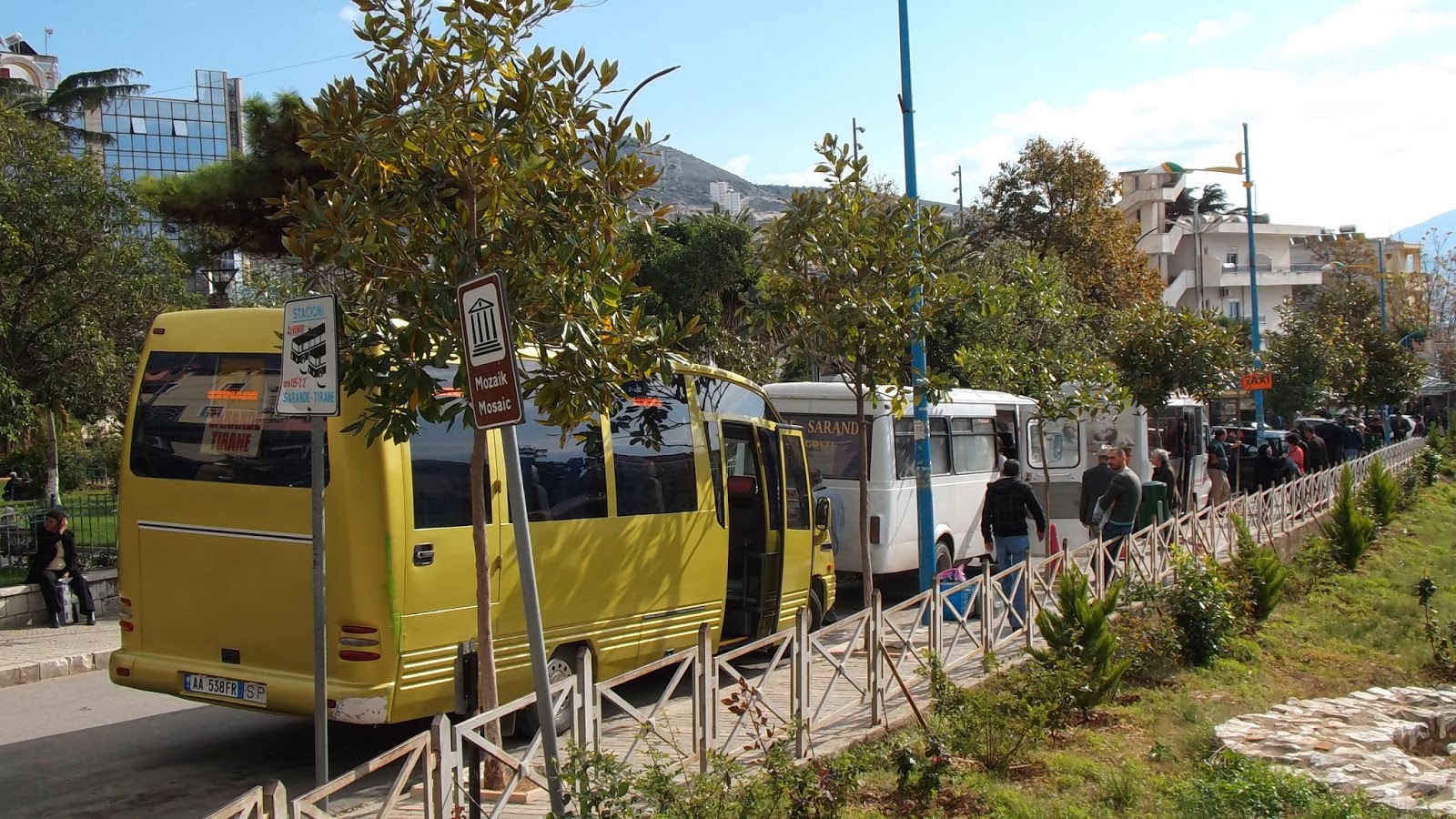
Buses and furgons
waiting to leave from Saranda
Finally, because of the
huge number of Albanians who live in Greece, many bus lines connect
Albanian cities to Athens, Thessaloniki, Volos, Patras and other
Greek cities daily. Bicycles are admitted on these buses, as
experienced by a couple of cycle travellers I met on the road.
MONTENEGRO
The website lists all the
daily local
and international
trains that travel across this tiny country.
The line Bar –
Belgrade, which takes about 8 hours, is described as one of the most
panoramic European railways, especially in the Montenegrin stretch
that runs along Lake Skadar and then crosses the Dinaric Alps.
Buses connect the towns
along the coast with each other and with the major cities in the
surroundings (Dubrovnik, Mostar, Sarajevo).
BOSNIA AND HERZEGOVINA
The website lists all the
local
and international
trains that travel across Bosnia-Herzegovina. Sarajevo is connected
to Zagreb (via Banja Luka) and to Ploče, on the Adriatic Sea (via
Mostar). The ticket for the train Sarajevo – Mostar (very beautiful
mountainous landscapes) costs 9,90 Bosnian marks (5 €) and the
additional fare for the bike costs 7 KM (3,50 €).

Sarajevo – Mostar on
a Swedish train of the 1960s...
Very comfortable seats and huge space
for the legs!
Countries
I didn't consider in this guide: Macedonia and Kosovo.
Overall,
when coming to plan a bike journey through the Balkans, the option of
combining biking with public transportation should be considered:
this choice can allow you to visit more places and/or skip some
climbs, travelling cheap and in a sustainable way.
Even
though the cycling infrastructures cannot be compared to Central
Europe, the Balkans have much to offer to those who wish to explore
this region, admire its naturalistic beauty and know more about the
history and the culture of its peoples.


