Showing posts with label Greece. Show all posts

7 November 2014

Top 5 cycling itineraries of A European Journey

I figured out that you can't be a cool (travel) blogger if you don't write useless lists like "the 27 places you ABSOLUTELY have to visit in your nineties" or "the 13 attractions you can't miss in Portobuffolè". So this is my personal way to enter in the olympus of travel bloggers.
(seriously, the use and abuse of the term "travel blogger" is disturbing)

Here is the top 5 list of the road I enjoyed the most while wandering around Europe with my bicycle:


5) Bayonne - Mimizan, France

Part of Eurovelo 1 (Atlantic Route), this itinerary runs for almost 100 km away from any major road, in the middle for the Landes forest, the biggest maritime-pine forest in Europe. The sounds and the smells that I felt during that ride trasmitted me a sense of peace that I can't describe.

https://www.facebook.com/media/set/?set=a.704809372892960.1073741845.502066989833867&type=3

https://www.facebook.com/media/set/?set=a.704809372892960.1073741845.502066989833867&type=3


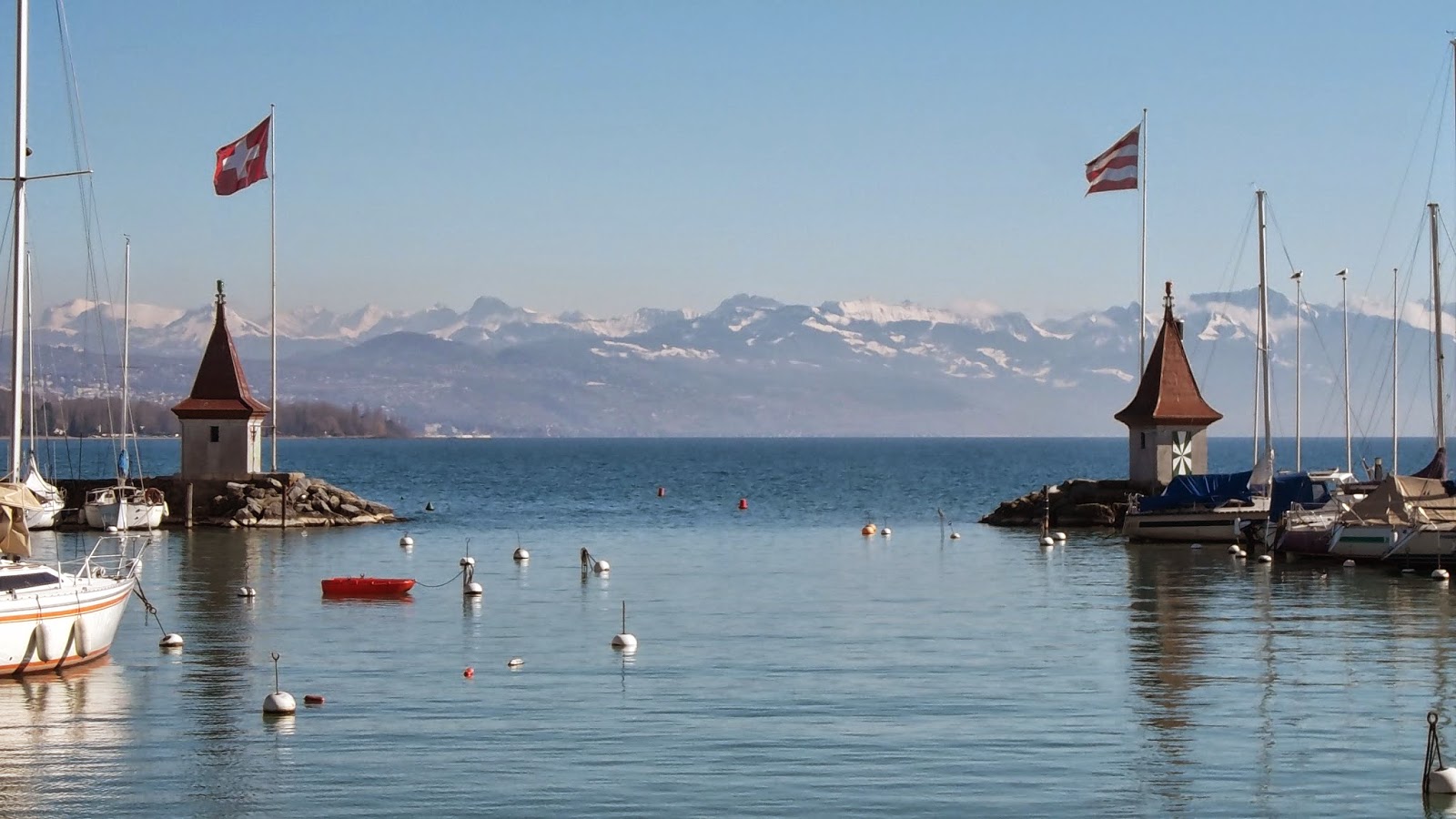
4) Lausanne - Geneva, Switzerland

If I could afford it, I wouldn't mind living in this area of Switzerland. For sure it has to do with wealth, but also with the natural beauty and the very high quality of life that can be perceived at first sight. The cycle itinerary that follows the north shore of Lake Geneva is part of the Rhone Route and is ideal to explore the region.

https://www.facebook.com/media/set/?set=a.704055296301701.1073741844.502066989833867&type=3

https://www.facebook.com/media/set/?set=a.704055296301701.1073741844.502066989833867&type=3


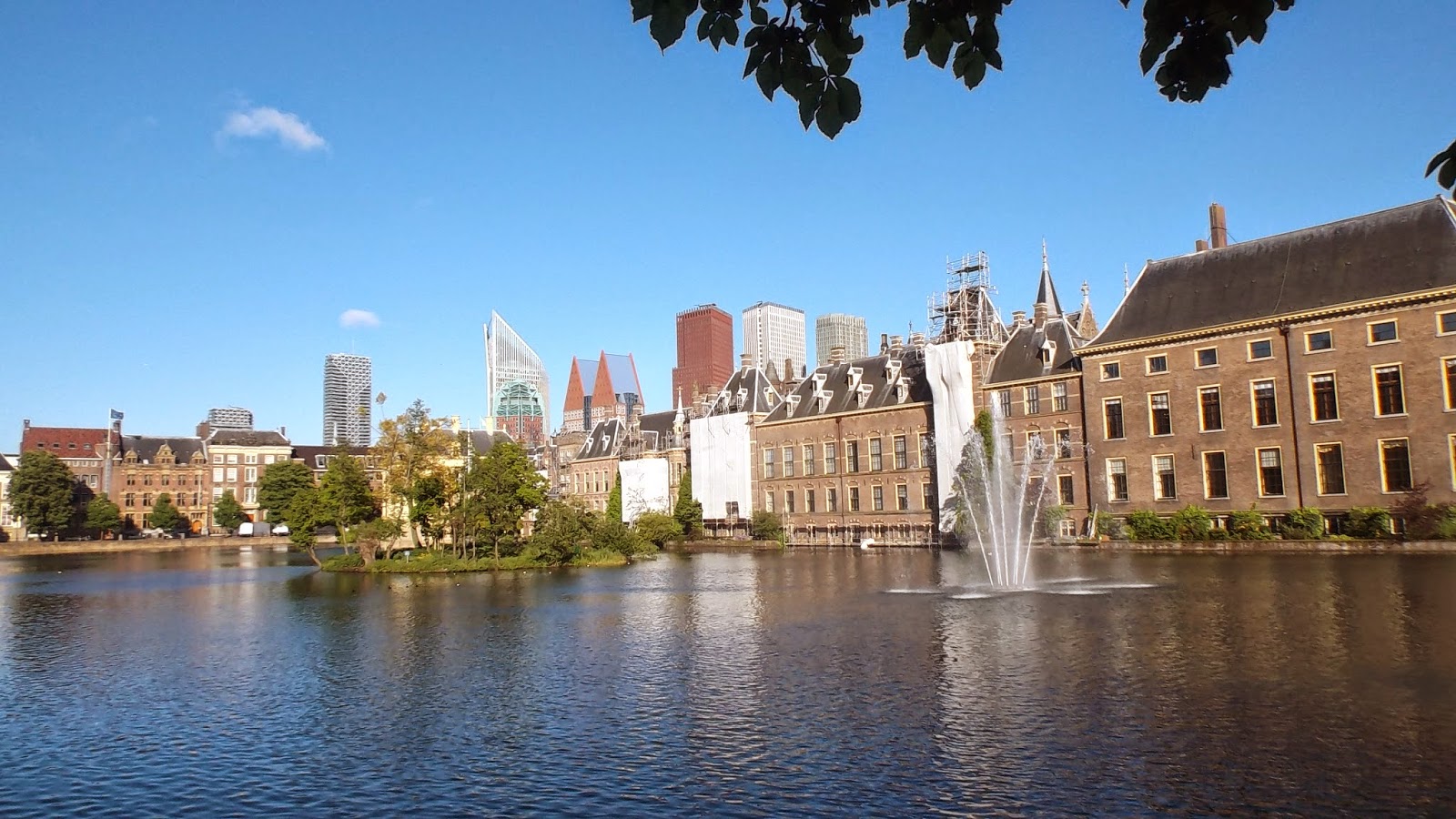
3) Rotterdam - Delft - Den Haag - Leiden, Netherlands

As far as bicycle culture, no country can be compared to the Netherlands: perfection in every detail. Amsterdam is a world-famous destination with its channels, but charming little cities like Delft and Leiden are perhaps even more special. This itinerary connects four cities in less than 40 km and is the dream of every urban cyclist. Observe, admire and try to import the model back home: the era of the bicycle has already begun.

https://www.facebook.com/media/set/?set=a.747570521950178.1073741852.502066989833867

https://www.facebook.com/media/set/?set=a.747570521950178.1073741852.502066989833867


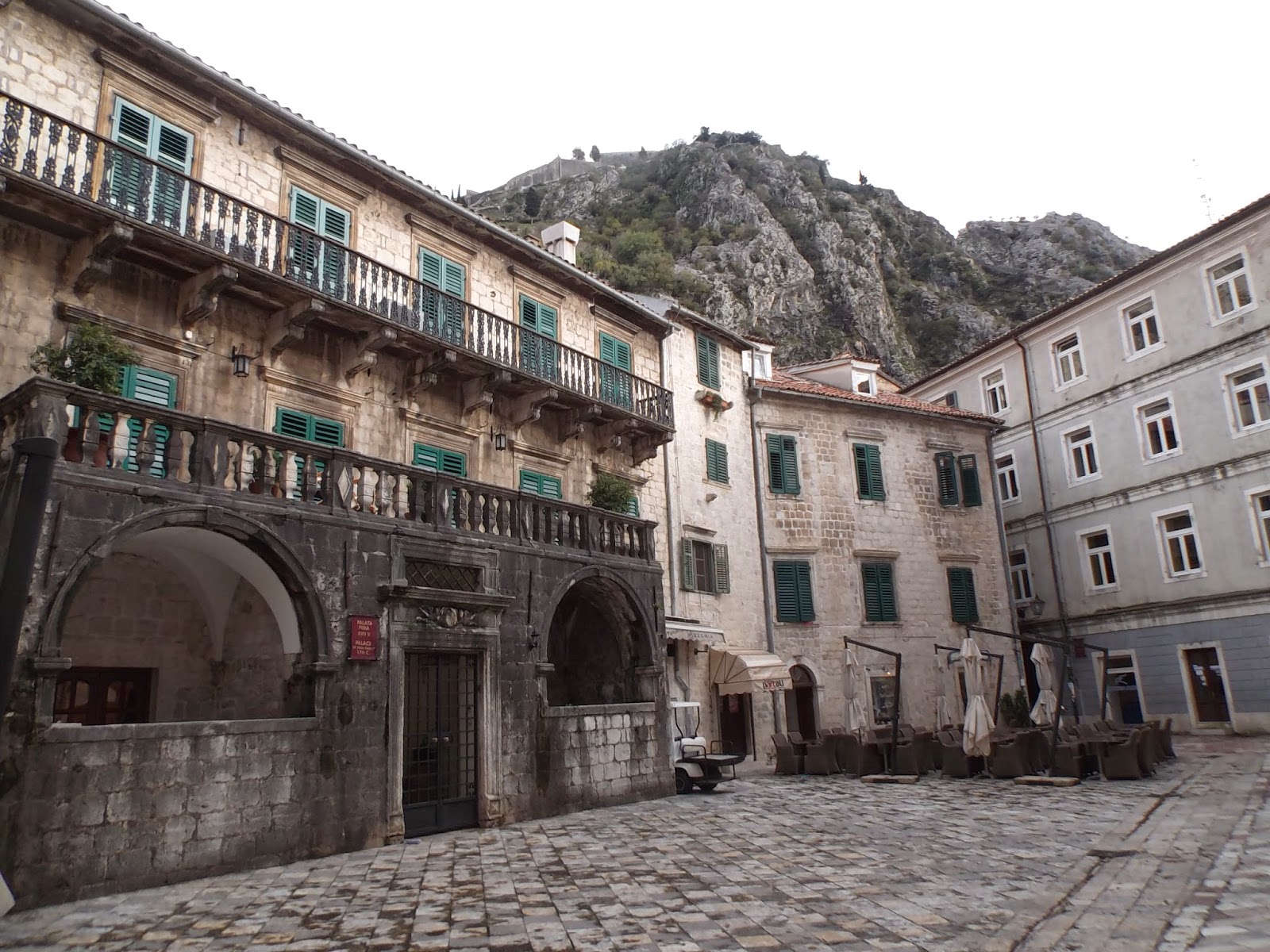
2) Bay of Kotor, Montenegro

The view from the top of the fortified walls that surround Kotor reminds a Norwegian fjord. Biking around the bay is even better: the buildings of the little towns (Kotor, Perast and others) have a unique style that dates back to the years of the Venetian Republic. The snow that covered Lovćen (1750 m) made up for a great contrast with the sea.

https://www.facebook.com/media/set/?set=a.658668357507062.1073741840.502066989833867&type=3

https://www.facebook.com/media/set/?set=a.658668357507062.1073741840.502066989833867&type=3

https://www.facebook.com/media/set/?set=a.658668357507062.1073741840.502066989833867&type=3


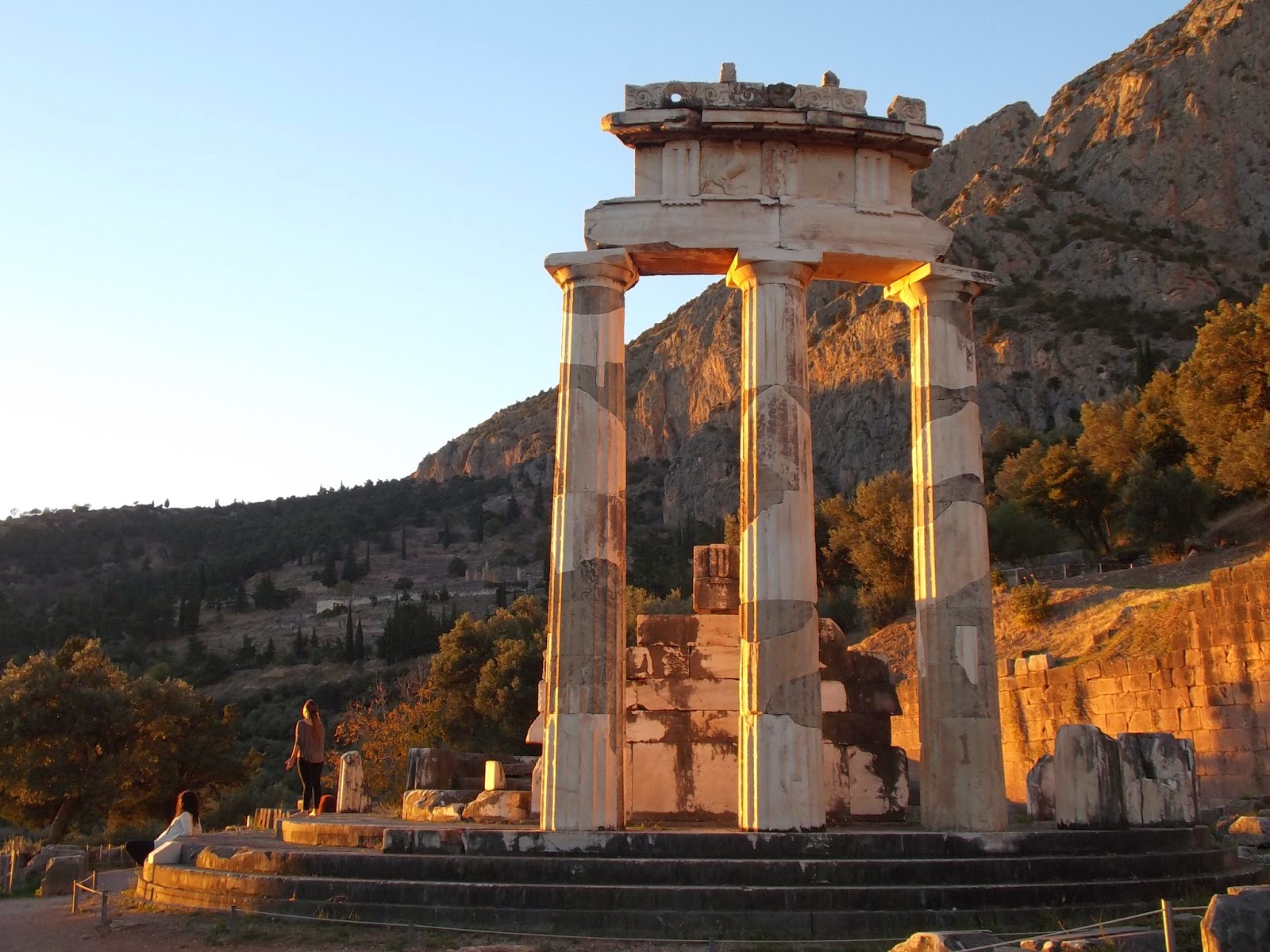
1) Itea - Delphi, Greece

About 15 kilometers uphill, from 0 to 600 m of elevation. Starting from the Gulf of Itea, you begin climbing slowly but steadily on a large road: in the summer it might be too hot and busy with tourist cars and buses, but when I was there at the beginning of November it was simply perfect. On one side the mountain range including Mount Parnassus, on the other side a huge valley covered by olive trees, with the sea at the horizon. After 2 hours of pleasant uphill riding, I reached Delphi and it was the only time in the whole trip in which I was sorry that the ascent was over. The visit at the archeological site and the amazing sunset completed an amazing day.
Sea, mountains, sun, olive trees, history and mythology all at once: hard to ask more than that.

https://www.facebook.com/media/set/?set=a.643326815707883.1073741837.502066989833867&type=1

https://www.facebook.com/media/set/?set=a.643326815707883.1073741837.502066989833867&type=1

https://www.facebook.com/media/set/?set=a.643326815707883.1073741837.502066989833867&type=1

https://www.facebook.com/media/set/?set=a.643326815707883.1073741837.502066989833867&type=1


5 February 2014

In the Balkans with bicycle and public transportation: a guide for the cycle traveller

2023 update: almost 10 years have passed since this post was written. Unfortunately most links are broken and the information is generally no longer reliable. Sorry!

This little guide wants to be a help for all the cycle travellers who are interested in visiting the Balkan countries, perhaps using public transportation for some parts of their journey. It's based on my personal experience (October-December 2013) and on information found in the Internet.

To search for trains, I suggest starting from a map of European railways and from Deutsche Bahn's search engine (which however does not include all countries).

Ferries connect Italy (Ancona, Bari, Brindisi) with Zadar, Split, Dubrovnik, Bar, Durres, Vlore, Igoumenitsa, Kerkira, Patras.

Here are the most relevant pieces of information, divided by country:


SLOVENIA

Bicycles are admitted on all the main lines that go from Ljubljana to Koper, Maribor and Jesenice/Bled. The additional fare is 3,20 €, no matter the distance you are going to travel.

Currently there are no trains that connect Italy to Slovenia. From Trieste you must cross the border with bicycle/bus to reach Sežana or Koper.


CROATIA

There are local trains and Intercity trains (not high-speed though). Usually Intercity trains connect Zagreb to the other main cities and some of them allow to transport bicycles (you can verify which ones offer this service on the official schedules at the train stations, anyway there is at least 1 train per day on every line). New trains, both regional and IC, have a big space for bicycles.
The additional ticket doesn't have a fixed price: it costs 30 kuna for the IC Split-Ogulin (7-hour travel), 41 kuna for Ogulin-Rijeka (regional, 2.5 hours).


Regional train Ogulin-Rijeka with compartment for bicycles

Buses are also commonly used: from what I could find on the web, however, bicycles are only allowed if they are approved by the driver, based on the season and on the available space in the luggage storage.


HUNGARY

The Hungarian railroad network is quite extended and regional trains also reach many very small villages. Bicycles can be carried in the dedicated space or in the head/back of the train, paying a ticket that costs 25% of the normal price for 1 person.

Budapest is also connected with international trains to Wien, Ljubljana, Prague, Belgrade and Berlin.


SERBIA

Serbian railway service is not so good. The majority of the national trains (not many, to be honest) run on the north-south line Subotica – Novi Sad – Belgrade – Niš. Almost all of them admit bicycles, but actually there's no storage space: you will probably have to stay in the very narrow aisle near the entrance doors and move the bicycle at every station to allow people to get on and off.
Prices are very low: a one-way ticket Novi Sad – Belgrade costs 300 dinars (less than 3 €), with a 100-dinar additional fare for the bike.

International trains leave daily from Belgrade to Zagreb, Budapest, Bar, Skopje and Sofia (1 or 2 every day). The journey Belgrade – Sofia takes 10 hours (at the average speed of 50 km/h) and includes a stop at the Serbian-Bulgarian border (where the Police searches for smugglers). The ticket costs about 20 € and there is no additional cost for the bike.
Just be aware of the fact that I was travelling during low season, when trains were not full. If you travel in the summer, things might be different! Always check in advance if your bicycle is admitted.


BULGARIA

Bicycles can be carried on all trains paying 2 lev (1 €), both on the modern trains (where there are more empty spaces for bicycles) and on the old ones (similar to the Serbian trains, with narrow doors and steep stairs). Normal train tickets are quite cheap in Bulgaria as well.


GREECE

Due to the mountains that occupy most of the mainland, Greek railway network is limited to the main lines Athens – Thessaloniki e Athens – Korinthos, with a few additional secondary lines. On Athens – Thessaloniki high-speed trains bicycles are admitted only if dismounted and closed in bike bags, like in Italian high-speed trains. In the other lines they can be carried without paying additional fees.
However, be aware that there are no “low-speed” trains that connect Athens with Northern Greece. Also, regions like Epirus don't have railways.

The most common public transport mode is the bus, in which bicycles are admitted without additional tickets if there is space in the luggage storage. Personally, I used the bus to go from Delphi to Athens and I was recommended to take the first bus at 7.30 am to avoid the more crowded ones.


ALBANIA

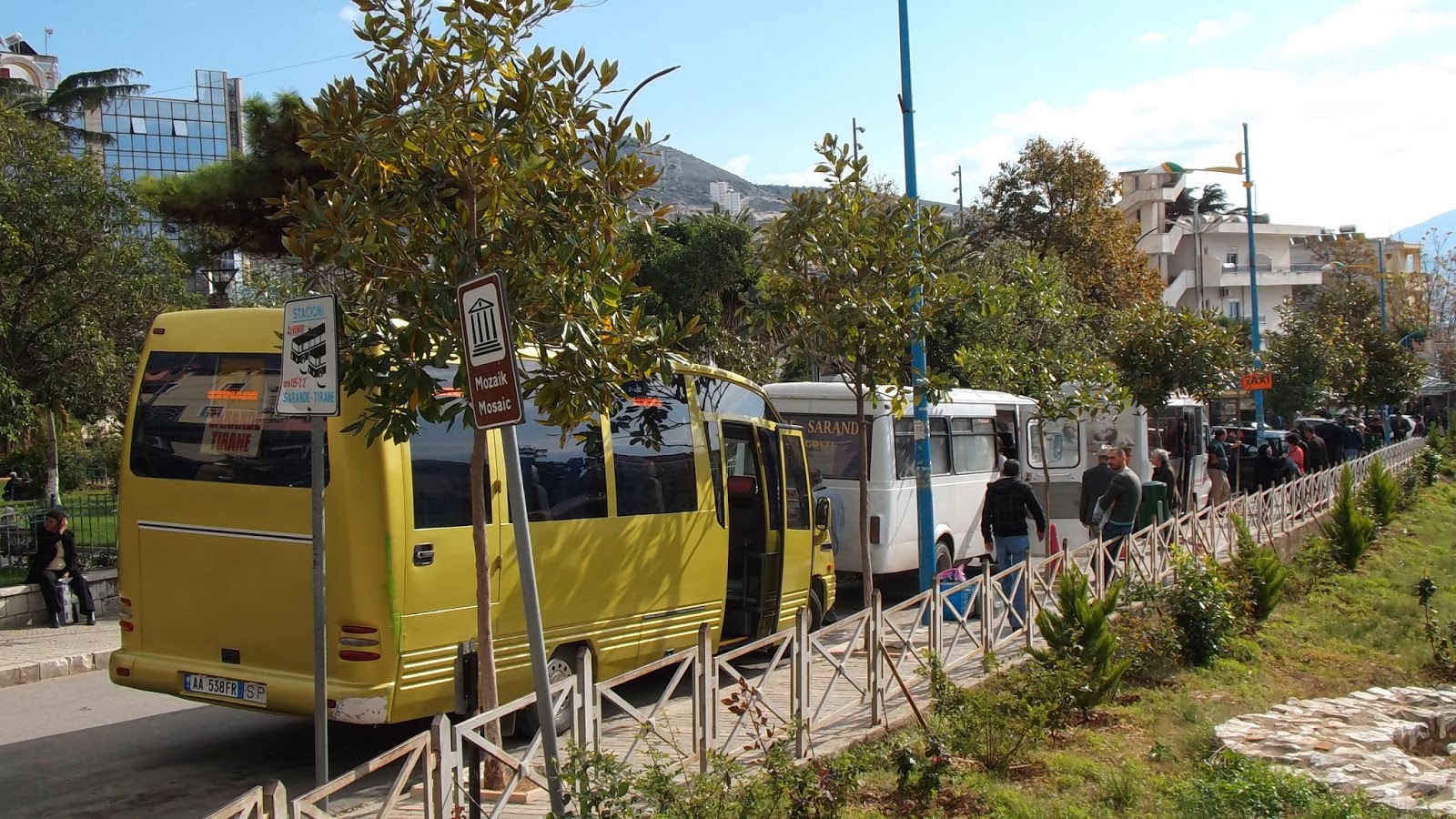
The railway network is almost abandoned and the most popular mean of transportation is the bus. There are “official companies” that offer services with fixed schedules (even if “schedule” is a big word!), and there are also the famous furgons (10-15 seats) that wait at the side of the road until they collect enough people who want to go to the proposed destination. Obviously bicycles can only be carried on the big coaches. The cost of the ticket is ridiculous: for example, the route Saranda – Tirana (via Gjirokastër, Fier, Durres, about 400 km in 6 hours) costs 1300 lek (9 €) + 300 lek (2 €) for the bike. Shkodër – Tirana: 300 + 300 lek.

In Albanian cities there are not real bus stations: different lines can start/arrive in different places, which often are not indicated, so you must find out in advance where is the waiting place for the bus you are interested in. Anyway, even if there's not a German-like organization, the atmosphere of a bus trip through Albania is something unique!


Buses and furgons waiting to leave from Saranda

Finally, because of the huge number of Albanians who live in Greece, many bus lines connect Albanian cities to Athens, Thessaloniki, Volos, Patras and other Greek cities daily. Bicycles are admitted on these buses, as experienced by a couple of cycle travellers I met on the road.


MONTENEGRO

The website lists all the daily local and international trains that travel across this tiny country.
The line Bar – Belgrade, which takes about 8 hours, is described as one of the most panoramic European railways, especially in the Montenegrin stretch that runs along Lake Skadar and then crosses the Dinaric Alps.

Buses connect the towns along the coast with each other and with the major cities in the surroundings (Dubrovnik, Mostar, Sarajevo).


BOSNIA AND HERZEGOVINA

The website lists all the local and international trains that travel across Bosnia-Herzegovina. Sarajevo is connected to Zagreb (via Banja Luka) and to Ploče, on the Adriatic Sea (via Mostar). The ticket for the train Sarajevo – Mostar (very beautiful mountainous landscapes) costs 9,90 Bosnian marks (5 €) and the additional fare for the bike costs 7 KM (3,50 €).


Sarajevo – Mostar on a Swedish train of the 1960s...
Very comfortable seats and huge space for the legs!


Countries I didn't consider in this guide: Macedonia and Kosovo.

Overall, when coming to plan a bike journey through the Balkans, the option of combining biking with public transportation should be considered: this choice can allow you to visit more places and/or skip some climbs, travelling cheap and in a sustainable way.

Even though the cycling infrastructures cannot be compared to Central Europe, the Balkans have much to offer to those who wish to explore this region, admire its naturalistic beauty and know more about the history and the culture of its peoples.

31 October 2013

Counter migration: from a big city to a little village

On my first night in Greece I was hosted by Stelios, who lives in Odigitria, a little village with 30 inhabitants.

Stelios's story is an interesting one: he was born and raised in Athens (population: 4 million people). After working for 3 different companies, 5 years ago he lost his job with Vodafone. He was 35 years old and he had a higher salary than the young people they were probably going to employ on his place (ethical company, isn't it?). Tired of the city life, which he never really appreciated, he decided to dramatically change his life and move back to the village from which his grandparents emigrated many years before. A little at a time he renovated his family's old house, which had been abandoned for 20 years, he got a dog and he started growing vegetables in the garden.


Then the economic crisis hit Greece, changing the life of many people. Now Stelios has a couple of temporary jobs, but he doesn't have a regular one. However, besides the current difficulties, Stelios would never move back to Athens: in Odigitria he found priceless things that he would never exchange with his past chaotic life: following the natural rhythm of the day, listening to the sound of the breeze that blows through the leaves, having an afternoon walk with his dog on the nearby hills right before sunset... He is not even "excluded" from the rest of the world, using Internet for communicating, reading news, hosting people with Couchsurfing and buying most of the things he needs.

Yes, he would like to have some money to travel as he used to do some years ago with his motorcycle. Yes, he wishes the government didn't put such high taxes on his old house. But, on the other hand, Stelios entirely owns his life and his time. How many people can say the same?

The story of Stelios is an interesting starting point to share some thoughts and open a discussion about city life vs rural life: everywhere in the world the migration pattern goes from villages to cities. People leave their native places to go to the cities to study or work. They end up never going back to their hometown, mainly because of opportunities: the city is a magnet which inevitably attracts the "metallic" materialistic part of us (basic needs like money and food, but also "luxuries"). Our dreaming part loses power, but never disappeares, because most city people still dream about exotic deserted beaches, mountain villages and huts, rural heavens, where they usually spend relaxing holidays. Yet, if rural or even "intermediate" areas could offer the same working and social opportunities of the cities, they would not hesitate to move there.

Now, the point is: 2013, Internet, e-commerce. Could it be an opportunity for a new and different development of rural areas? Little villages have been associated with poverty, agriculture, bad education, while cities have been praised for their industry, opportunites, education. Does this make sense in the Information Age? Can the mountain villages in the Alps and the fishing villages of Portugal pursue a new model of development?


Last but not least: the human factor. More people often equals more conformity and less self-discovery. Take Milan, London, Zagreb, Belgrade, Sofia. The cities are different, but people do the same things everywhere. It's unbelievable, if you think at it.
Take Pierre (South Dakota, USA), Cornuda (Veneto, Italy), Mala Subotica (Međimurje, Croatia), Odigitria (Central Macedonia, Greece). These places are unique. There lies the heart and the culture of a country.