30 June 2014

Lista del materiale per il mio viaggio

Alcune considerazioni introduttive:
  • Peso totale delle borse: 15-20 kg, a seconda della quantità di cibo e della stagione (ho lasciato alcune cose a casa nelle 2 pause di dicembre-gennaio e di aprile).
  • Potrei aver dimenticato qualcosa nella lista.
  • Dato che l'obiettivo principale del viaggio era quello di conoscere persone ed entrare nella cultura dei posti visitati, ho deciso di partire senza tenda e senza cucina da campo. (In totale 120 notti come ospite, 57 notti in ostelli/camere. Più dettagli a riguardo prossimamente.)
  • Grazie a coloro che mi hanno aiutato con il materiale prima e durante il viaggio: oltre all'ovvio vantaggio economico, mi hanno dato anche una spinta morale per portare a termine questo progetto. Un grazie particolare a Giampaolo per il supporto.


Ecco la lista:


Documenti

Carta d'identità e passaporto (mai usato)
Tessera sanitaria
Tessera universitaria
Soldi e carte

Farmacia

Paracetamolo
Benagol
Aspirina
Nimesulide
Spray di propoli
Cerotti
Benda elastica
Disinfettante
Burrocacao

Igiene

Docchiaschiuma
Deodorante
Spazzolino e dentifricio
Detersivo in polvere
Rasoio
Forbicine
Fazzoletti
Spray deodorante per scarpe

Tecnologia

Telefono (Nokia Lumia 620 con mappe stradali gratuite utilizzabili offline)
Macchina fotografica + scheda SD
IPod Touch
Laptop
EyeCam
Cavi per ricaricare tutte queste cose
Chiavetta USB

Vestiti

Giacca a vento
Gilet Sportmarket
Giacca Sportful Hot Pack ultralight
Giacca da sci di fondo Sportful
Felpa
Maglia di lana maniche lunghe
2 maglie sportive invernali maniche lunghe
2 magliette Duerocche e Delineodesign
3 magliette traspiranti sportive

Pantaloni invernali sportivi Salewa
2 pantaloni leggeri con zip al ginocchio (corti/lunghi)

Mutande: 2 imbottite da ciclismo + 5 normali
Calzini: 6 paia (3 di Elite)

Scarpe: SCARPA Enduro Gtx
Ciabatte

Guanti da sci di fondo Sportful
2 bandane Buff
Berretto


Materiale per la bici

Pompa
Camere d'aria
Raggi
Tiraraggi
Chiavi a brugola
Cacciavite
Viti e dadi vari
Pinza
Olio
Corda estensibile
Filo di ferro
Nastro adesivo
Lucchetto


Altro

Occhiali
Occhiali da sole
Asciugamano in microfibra
Sacco a pelo

Casco
Giacca catarifrangente
Lampada frontale Petzl (grazie a Sportmarket)
Fischietto
Coltello, cucchiaio e forchetta
Sasso, carta e forbice

(Mappe)
(Dizionario di greco/francese/spagnolo)


Cibo


Borse

Zaino: Ospreys Manta 28 (grazie a SCARPA)


Equipment list for my European journey

A few introductory notes:

  • Total weight of all the bags: 15-20 kg, depending on the amount of food and on the season (I left some things at home in each of my 2 breaks in December-January and in April).
  • Although I have checked it a few times, I might have forgotten something in the list.
  • Since the major goal of my trip was to meet people and fully experience the culture of the places I was visiting, I decided not to carry a tent and cooking equipment with me. (sleeping: 120 nights hosted, 57 nights in hostels or rooms. More details in another post in the future)
  • Thanks to those who supported me with materials before and during this trip: besides the obvious economic advantage, they made me more confident in the possibility of completing this project. Special thanks to Giampaolo for the huge help.


Now the list:


Documents

National ID + Passport (never used)
Italian Health Insurance Card
University Card
Money and cards

Pharmacy

Paracetamol
Strepsil
Aspirin
Nimesulide
Propolis spray
Bandages (adhesive and elastic)
Disinfectant
Lip balm

Hygiene

Shower gel
Deodorant
Toothbrush and paste
Washing powder
Razor
Little scissors
Pocket tissues
Shoe deodorizer spray

Tecnology

Phone (Nokia Lumia 620: free maps to download and use offline)
Camera + SD card
IPod Touch
Laptop
EyeCam
Chargers for all of the above
Pendrive

Clothes

Wind jacket
Sportmarket sleeveless jacket
Sportful Hot Pack ultralight jacket
Sportful cross-country skiing jacket
Sweatshirt
Long sleeve woolen shirt
2 warm long sleeve shirts
2 t-shirts Duerocche and Delineodesign
3 sport t-shirts

Heavy trousers
2 lightweight trousers (with zip to make them long/short)

Underwear: 2 for cycling + 5 normal
Socks: 6 pairs (3 by Elite)

Shoes: SCARPA Enduro Gtx
Flip-flops

Sportful winter cross country skiing gloves
2 Buff headwear
Cap


Bike equipment

Pump
Tubes
Spokes
Spoke wrench
Allen keys
Screwdriver
Screws and nuts
Pliers
Oil
Stretchable rope
Lock


Other things

Eyeglasses
Sunglasses
Microfiber towel
Sleeping bag

Cycling helmet
Reflective jacket
Petzl headlamp (thanks to Sportmarket)
Whistle
Knife, spoon, fork

(Map)
(Greek/French/Spanish dictionary)


Food


Bags

Ospreys Manta 28 Backpack (thanks to SCARPA)


20 June 2014

Back home, but the journey will never end

The blog hasn't been updated at all recently. I figured that the Facebook page is more visited and works better for the type of communication I wanted to carry on while travelling.

Anyway, I also kept my own diary with notes, comments and memories of the journey. It will take some time (a few months, at least) to reorganize it and obtain some decent material to share, but right now I'm motivated and willing to do it, with no hurry. Stay tuned :)

15 March 2014

95 days and looking beyond

“Official” communication:

I'm getting closer to the 100th day of this journey. I had great expectations about it and I was right, because so far everything has been outstanding: roads, landscapes, cities, and above all the people I have met.

On July 31, when I told my project to the world, my little world, I had no idea of how things could go, nor I knew if I could actually achieve something that is for sure beyond my possibilities, if I were to give a judgement that is only based on rationality.

In these 3 months (actually 2+1) I've seen, learnt and said a lot of things. Perhaps I will need years to understand and digest all the information and the emotions I lived. At the same time, while still living this dream, I've already had the chance to meditate about it and about other important things for me (plenty of hours on the saddle must be worth something!): new needs arise, new projects come to my mind, new emotions take the place of the old ones.

It's a matter of priorities: important things must stay on top of the list, always. Whatever they are.

For this reason (consequence of other personal reasons), I've made a decision about the continuation of AEuropean Journey: I won't go to Scandinavia and to the Baltic countries. Instead, the journey will continue as originally planned until Northern Germany (end of May). I will then turn south, following an itinerary not yet defined (I'm open to suggestions!)... Maybe something like this: Hamburg – Leipzig – Dresden – Prague – Krakow – Budapest – Wien – Graz – Italy, finishing at the end of June. Talking about boring statistics, at the end A European Journey will be made of 180-200 days, 10000-11000 km by bike, 5000-6000 km by public transportation.

More important, I'll try to keep going with the same spirit until the end: meeting people, learning and sharing, couchsurfing, having fun, cycling, breathing, smiling.
Norway and North Cape are still a dream, but now I know I can wait, organize another trip in the next future and live it to the full: besides being a more introspective and solitary experience, it might be worth doing it by its own and not after several months on the road.


5 February 2014

In the Balkans with bicycle and public transportation: a guide for the cycle traveller

2023 update: almost 10 years have passed since this post was written. Unfortunately most links are broken and the information is generally no longer reliable. Sorry!

This little guide wants to be a help for all the cycle travellers who are interested in visiting the Balkan countries, perhaps using public transportation for some parts of their journey. It's based on my personal experience (October-December 2013) and on information found in the Internet.

To search for trains, I suggest starting from a map of European railways and from Deutsche Bahn's search engine (which however does not include all countries).

Ferries connect Italy (Ancona, Bari, Brindisi) with Zadar, Split, Dubrovnik, Bar, Durres, Vlore, Igoumenitsa, Kerkira, Patras.

Here are the most relevant pieces of information, divided by country:


SLOVENIA

Bicycles are admitted on all the main lines that go from Ljubljana to Koper, Maribor and Jesenice/Bled. The additional fare is 3,20 €, no matter the distance you are going to travel.

Currently there are no trains that connect Italy to Slovenia. From Trieste you must cross the border with bicycle/bus to reach Sežana or Koper.


CROATIA

There are local trains and Intercity trains (not high-speed though). Usually Intercity trains connect Zagreb to the other main cities and some of them allow to transport bicycles (you can verify which ones offer this service on the official schedules at the train stations, anyway there is at least 1 train per day on every line). New trains, both regional and IC, have a big space for bicycles.
The additional ticket doesn't have a fixed price: it costs 30 kuna for the IC Split-Ogulin (7-hour travel), 41 kuna for Ogulin-Rijeka (regional, 2.5 hours).


Regional train Ogulin-Rijeka with compartment for bicycles

Buses are also commonly used: from what I could find on the web, however, bicycles are only allowed if they are approved by the driver, based on the season and on the available space in the luggage storage.


HUNGARY

The Hungarian railroad network is quite extended and regional trains also reach many very small villages. Bicycles can be carried in the dedicated space or in the head/back of the train, paying a ticket that costs 25% of the normal price for 1 person.

Budapest is also connected with international trains to Wien, Ljubljana, Prague, Belgrade and Berlin.


SERBIA

Serbian railway service is not so good. The majority of the national trains (not many, to be honest) run on the north-south line Subotica – Novi Sad – Belgrade – Niš. Almost all of them admit bicycles, but actually there's no storage space: you will probably have to stay in the very narrow aisle near the entrance doors and move the bicycle at every station to allow people to get on and off.
Prices are very low: a one-way ticket Novi Sad – Belgrade costs 300 dinars (less than 3 €), with a 100-dinar additional fare for the bike.

International trains leave daily from Belgrade to Zagreb, Budapest, Bar, Skopje and Sofia (1 or 2 every day). The journey Belgrade – Sofia takes 10 hours (at the average speed of 50 km/h) and includes a stop at the Serbian-Bulgarian border (where the Police searches for smugglers). The ticket costs about 20 € and there is no additional cost for the bike.
Just be aware of the fact that I was travelling during low season, when trains were not full. If you travel in the summer, things might be different! Always check in advance if your bicycle is admitted.


BULGARIA

Bicycles can be carried on all trains paying 2 lev (1 €), both on the modern trains (where there are more empty spaces for bicycles) and on the old ones (similar to the Serbian trains, with narrow doors and steep stairs). Normal train tickets are quite cheap in Bulgaria as well.


GREECE

Due to the mountains that occupy most of the mainland, Greek railway network is limited to the main lines Athens – Thessaloniki e Athens – Korinthos, with a few additional secondary lines. On Athens – Thessaloniki high-speed trains bicycles are admitted only if dismounted and closed in bike bags, like in Italian high-speed trains. In the other lines they can be carried without paying additional fees.
However, be aware that there are no “low-speed” trains that connect Athens with Northern Greece. Also, regions like Epirus don't have railways.

The most common public transport mode is the bus, in which bicycles are admitted without additional tickets if there is space in the luggage storage. Personally, I used the bus to go from Delphi to Athens and I was recommended to take the first bus at 7.30 am to avoid the more crowded ones.


ALBANIA

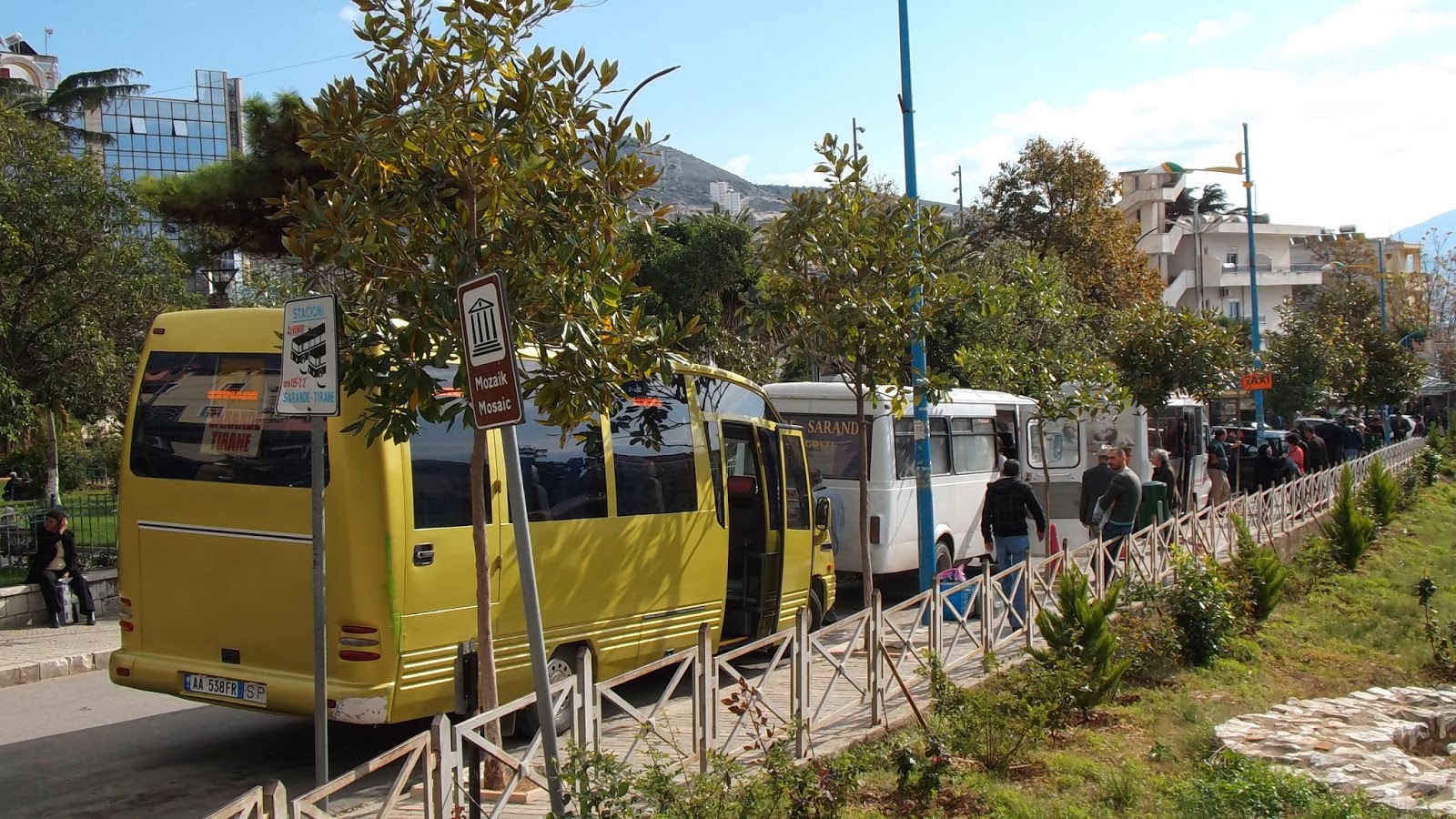
The railway network is almost abandoned and the most popular mean of transportation is the bus. There are “official companies” that offer services with fixed schedules (even if “schedule” is a big word!), and there are also the famous furgons (10-15 seats) that wait at the side of the road until they collect enough people who want to go to the proposed destination. Obviously bicycles can only be carried on the big coaches. The cost of the ticket is ridiculous: for example, the route Saranda – Tirana (via Gjirokastër, Fier, Durres, about 400 km in 6 hours) costs 1300 lek (9 €) + 300 lek (2 €) for the bike. Shkodër – Tirana: 300 + 300 lek.

In Albanian cities there are not real bus stations: different lines can start/arrive in different places, which often are not indicated, so you must find out in advance where is the waiting place for the bus you are interested in. Anyway, even if there's not a German-like organization, the atmosphere of a bus trip through Albania is something unique!


Buses and furgons waiting to leave from Saranda

Finally, because of the huge number of Albanians who live in Greece, many bus lines connect Albanian cities to Athens, Thessaloniki, Volos, Patras and other Greek cities daily. Bicycles are admitted on these buses, as experienced by a couple of cycle travellers I met on the road.


MONTENEGRO

The website lists all the daily local and international trains that travel across this tiny country.
The line Bar – Belgrade, which takes about 8 hours, is described as one of the most panoramic European railways, especially in the Montenegrin stretch that runs along Lake Skadar and then crosses the Dinaric Alps.

Buses connect the towns along the coast with each other and with the major cities in the surroundings (Dubrovnik, Mostar, Sarajevo).


BOSNIA AND HERZEGOVINA

The website lists all the local and international trains that travel across Bosnia-Herzegovina. Sarajevo is connected to Zagreb (via Banja Luka) and to Ploče, on the Adriatic Sea (via Mostar). The ticket for the train Sarajevo – Mostar (very beautiful mountainous landscapes) costs 9,90 Bosnian marks (5 €) and the additional fare for the bike costs 7 KM (3,50 €).


Sarajevo – Mostar on a Swedish train of the 1960s...
Very comfortable seats and huge space for the legs!


Countries I didn't consider in this guide: Macedonia and Kosovo.

Overall, when coming to plan a bike journey through the Balkans, the option of combining biking with public transportation should be considered: this choice can allow you to visit more places and/or skip some climbs, travelling cheap and in a sustainable way.

Even though the cycling infrastructures cannot be compared to Central Europe, the Balkans have much to offer to those who wish to explore this region, admire its naturalistic beauty and know more about the history and the culture of its peoples.

9 January 2014

The moral duty of a traveller

I read some interesting thoughts about travelling and education on the Out of Eden Walk's blog. I already talked about this project a few weeks ago on this post.
Here is my take about travelling, education and how the two things are related.

Besides posting nice pictures, giving tips on places to see and writing how cool travelling is, I deeply believe that travellers have a very important task and a moral duty.

Even though it's easier than what most people think, travelling is not for everyone, because of possibilities, attitudes, personal problems and other impediments. For this reason, travellers are lucky to be able to live some experiences (unforgettable meetings, discovery of new cultures, breathtaking views, etc.) that are precluded to those who cannot travel. Travelling means learning, extending one's knowledge, making connections, widening perspectives and, at the end, developing a global consciousness.

We are lucky enough to have technologies that allow people to spread information as never before. While sharing travelling stories through a screen doesn't give the same emotions as going on a real journey, it can surely inspire other people. The least a traveller can do is saying "look, the real world is different than what you might imagine, there's a lot to discover out there, the people we call foreigners are not as bad as they make us think, go check it out yourself if you can". In this way, the traveller's individual growth is extended to the society around him.

In my opinion, travelling and education are strongly connected.
Go, learn, understand, share: that's the moral duty of a traveller.
A hundred times a day I remind myself that my inner and outer life depend on the labors of other men, living and dead, and that I must exert myself in order to give in the measure as I have received and am still receiving. (Albert Einstein)

7 January 2014

News

La Tribuna di Treviso, a local newspaper, published an article about A European Journey, written by Annamaria Serena. Here it is:


Additionally, on January 16 I'm going to talk about my experience in Staranzano (Gorizia), during a series of nights about cycle travelling organized by the association FIAB - Bisiachinbici. Here's the event, if you happen to be around that area at that time:


Going back to the real deal: don't worry, I'll be back on the road pretty soon, probably in the first half of February!

Stay tuned on Facebook and Twitter!

18 December 2013

Migration: Paul Salopek's Out of Eden Walk

December 18 is International Migrants Day.

Migrations have frequently occurred in the recent history of mankind, almost everywhere around the world. Now, since the world is becoming smaller and smaller, the migration routes are becoming big highways: today more than 200 million people are migrants, according to the data of the United Nations.

Yet, migration is far from being considered a normal phenomenon, especially when it comes to seeing foreigners arrive in our own country. Immigration and emigration have changed the history of many European countries, with some dramatic cases standing out: around half of the Albanians live away from their countries of origin (Albania and Kosovo).
Millions of Europeans left in search of a better life in North and South America, and it's been only after World War II that Europe has started receiving a considerable amount of immigrants.

But... Where did it all begin? Africa, Rift Valley. After wandering around the Continent for a while, our common ancestors decided to walk around the globe and set foot on most of the lands of this planet.

Now, in 2013, the journalist Paul Salopek (read biography here) has decided to walk on the pathways of the humans who first colonized the world: he started an awesome, mind-blowing 7-year journey by foot, beautifully documented in his project called Out of Eden Walk.

Give a look to the website and to the related contents: simply amazing!
"The guiding star of the walk’s storyline isn’t me. It’s the journey itself, the swarm of ideas and people encountered along the road. The opportunities to link the ambulatory journalism to education are nearly limitless." (Paul Salopek)


Out of Eden Walk Trailer from Out of Eden Walk on Vimeo.

13 December 2013

European toponymy* and synecdoches**

* Toponymy: "the study of place names"
** Synecdoche: "a figure of speech in which a part is made to represent the whole or vice versa [...]"

The following post wants to address an important issue, because, as Chris McCandless said, it is important "to call each thing by its right name". As Mandela said, it is also important not to randomly quote famous people, but that's another issue.

"Bosnia"

Level 1: Bosnia is a geographical region, but it is not a country. Bosnia and Herzegovina IS a country. Herzegovina is also a region. The region of Bosnia and the region of Herzegovina together form (guess what?) Bosnia and Herzegovina.
Level 2: People from Bosnia are called Bosnians. People from Herzegovina are called Herzegovinians. People from Bosnia and Herzegovina are generally called Bosnians, even though if you say "Bosnian" to a person from Mostar you might be corrected to "Herzegovinian".
Level 3: Bosnia and Herzegovina (abbreviation: BiH) is divided into 2 entities, Republika Srpska and Federation of Bosnia and Herzegovina (or simply "Federation"). Republika Srpska of course IS NOT the Republic of Serbia (which is the formal name for Serbia, by the way). Federation of Bosnia and Herzegovina obviously IS NOT Bosnia and Herzegovina, just one of its two parts.
Level 4: The official capital of Republika Srpska is Sarajevo, but the National Assembly and the Government are based in Banja Luka. The capital of the Federation is also Sarajevo. The capital of Bosnia and Herzegovina is... (drum beats) ...Sarajevo!
Level 5: In Bosnia and Herzegovina there are 3 "ethnic groups", which mostly reflect the religious affiliation of the Bosnians: Bosniaks (= Bosnian Muslims), Croats (Catholic) and Serbs (Orthodox). Republika Srpska has a majority of Serbs, the Federation has a majority of Bosniaks, although some cities (especially in Herzegovina) have a Croat majority.
Level 6: Bosnian Croats are Croats (of course!). Croatians are also Croats. If I understood correctly (it's level 6, guys!), a Croatian is a citizen of Croatia; "Croats", on the other hand, defines the "ethnic group". But in Italian, Croatian and Croat are both translated with "croati"...

"Macedonia"

- The Republic of Macedonia is the formal name of the country that is called Macedonia by most people in the world.
- Macedonia is also a region of Greece. Its biggest city is Thessaloniki.
- Macedonia is also an historical region which includes Macedonia (region of Greece), the Republic of Macedonia, and parts of surrounding countries.
- The Republic of Macedonia IS NOT called Macedonia by the Greek people. Instead, it is called "Former Yugoslavian Republic Of Macedonia" (FYROM).


Last but not least, macedonia is the common word used in Italy to indicate the fruit salad...

"Holland"

HOLLANDE IS NOT A COUNTRY! (caps lock required...)
This funny video explains the whole deal:


"England"

Although this blog specifically deals with Europe, this is als... What? Oh yes, "England" is actually a part of Europe, they told me.


"Friuli"

Andate a Trieste e rivolgetevi ad un triestino chiamandolo "furlan". E capirete.

10 December 2013

One important thing and many boring statistics

Important thing

This is something I wrote a few months ago, after I started hosting and meeting people through Couchsurfing and Warmshowers in Coimbra. After 2 months playing the part of the "surfer", it got an even greater meaning:
[...] maybe the greatest life lesson has come from couchsurfing. We are often warned about how dangerous the world is and how wrong it is to trust a stranger. But we forget that we are strangers in the eyes of every traveller and that our behaviour can influence his/her opinion about our own town, our country or even the goodness of mankind. By defeating fear and prejudice towards other people, we are always rewarded with some good moments which remind us that, after all, "there is some good in this world, and it's worth fighting for". Stay human.
Thanks to all the "strangers" that turned into friends!


Boring statistics

64 days.
63 nights in 43 different places.
44 nights hosted by someone, 17 nights in hostels/rooms, 2 nights on overnight trains.

18 borders crossed.
11 countries.
7 capitals: Ljubljana, Zagreb, Belgrade, Sofia, Athens, Tirana and Sarajevo.

2580 km by bike.
2500-3000 km by train or bus.
135 km on the longest biking day (November 18, from Parga to Sarande).

16 trains.
4 buses.
1 ferryboat.
1 bicycle.

15 km/h: normal average on a hilly day for the first week, when I was out of shape.
18 km/h: normal average on a hilly day after 1 month.
8 km/h: reasonable speed on a 6-8% climb.
58 km/h: maximum speed.

33x16, 33x18, 33x20: most used gears (= 3,5-4,5 metres per pedal revolution).
10^5 - 10^6: order of magnitude for the number of pedal revolutions during the journey.

75 kg: my weight.
~ 18-20 kg: total weight of the bags.
~ 15 kg: weight of the bicycle.

Max temperature: 28°C, 4/11/2013 in Thessaly, Greece
Min temperature: -3°C, 29/11/2013 in Sarajevo, Bosnia and Herzegovina (not biking though...)

1 puncture.
0 other significant problems with the bicycle.

~ 850 € spent during the journey, of which:
230 € on accomodation
200 € on transportation
30-40 € on museum entrances and other tickets
20 € on the bicycle
almost all the rest on food/drinks (5-6 € per day)

Countries for number of visits in the blog: Italy (3000), Croatia (1100), USA (300), Greece, New Zealand, Brazil, Germany, France, Spain, Slovenia, Portugal...

0 kg lost while travelling.
100-120 g: average quantity of chocolate I ate everyday.
3 damn good tiramisù made.