5 February 2014

In the Balkans with bicycle and public transportation: a guide for the cycle traveller

2023 update: almost 10 years have passed since this post was written. Unfortunately most links are broken and the information is generally no longer reliable. Sorry!

This little guide wants to be a help for all the cycle travellers who are interested in visiting the Balkan countries, perhaps using public transportation for some parts of their journey. It's based on my personal experience (October-December 2013) and on information found in the Internet.

To search for trains, I suggest starting from a map of European railways and from Deutsche Bahn's search engine (which however does not include all countries).

Ferries connect Italy (Ancona, Bari, Brindisi) with Zadar, Split, Dubrovnik, Bar, Durres, Vlore, Igoumenitsa, Kerkira, Patras.

Here are the most relevant pieces of information, divided by country:


SLOVENIA

Bicycles are admitted on all the main lines that go from Ljubljana to Koper, Maribor and Jesenice/Bled. The additional fare is 3,20 €, no matter the distance you are going to travel.

Currently there are no trains that connect Italy to Slovenia. From Trieste you must cross the border with bicycle/bus to reach Sežana or Koper.


CROATIA

There are local trains and Intercity trains (not high-speed though). Usually Intercity trains connect Zagreb to the other main cities and some of them allow to transport bicycles (you can verify which ones offer this service on the official schedules at the train stations, anyway there is at least 1 train per day on every line). New trains, both regional and IC, have a big space for bicycles.
The additional ticket doesn't have a fixed price: it costs 30 kuna for the IC Split-Ogulin (7-hour travel), 41 kuna for Ogulin-Rijeka (regional, 2.5 hours).


Regional train Ogulin-Rijeka with compartment for bicycles

Buses are also commonly used: from what I could find on the web, however, bicycles are only allowed if they are approved by the driver, based on the season and on the available space in the luggage storage.


HUNGARY

The Hungarian railroad network is quite extended and regional trains also reach many very small villages. Bicycles can be carried in the dedicated space or in the head/back of the train, paying a ticket that costs 25% of the normal price for 1 person.

Budapest is also connected with international trains to Wien, Ljubljana, Prague, Belgrade and Berlin.


SERBIA

Serbian railway service is not so good. The majority of the national trains (not many, to be honest) run on the north-south line Subotica – Novi Sad – Belgrade – Niš. Almost all of them admit bicycles, but actually there's no storage space: you will probably have to stay in the very narrow aisle near the entrance doors and move the bicycle at every station to allow people to get on and off.
Prices are very low: a one-way ticket Novi Sad – Belgrade costs 300 dinars (less than 3 €), with a 100-dinar additional fare for the bike.

International trains leave daily from Belgrade to Zagreb, Budapest, Bar, Skopje and Sofia (1 or 2 every day). The journey Belgrade – Sofia takes 10 hours (at the average speed of 50 km/h) and includes a stop at the Serbian-Bulgarian border (where the Police searches for smugglers). The ticket costs about 20 € and there is no additional cost for the bike.
Just be aware of the fact that I was travelling during low season, when trains were not full. If you travel in the summer, things might be different! Always check in advance if your bicycle is admitted.


BULGARIA

Bicycles can be carried on all trains paying 2 lev (1 €), both on the modern trains (where there are more empty spaces for bicycles) and on the old ones (similar to the Serbian trains, with narrow doors and steep stairs). Normal train tickets are quite cheap in Bulgaria as well.


GREECE

Due to the mountains that occupy most of the mainland, Greek railway network is limited to the main lines Athens – Thessaloniki e Athens – Korinthos, with a few additional secondary lines. On Athens – Thessaloniki high-speed trains bicycles are admitted only if dismounted and closed in bike bags, like in Italian high-speed trains. In the other lines they can be carried without paying additional fees.
However, be aware that there are no “low-speed” trains that connect Athens with Northern Greece. Also, regions like Epirus don't have railways.

The most common public transport mode is the bus, in which bicycles are admitted without additional tickets if there is space in the luggage storage. Personally, I used the bus to go from Delphi to Athens and I was recommended to take the first bus at 7.30 am to avoid the more crowded ones.


ALBANIA

The railway network is almost abandoned and the most popular mean of transportation is the bus. There are “official companies” that offer services with fixed schedules (even if “schedule” is a big word!), and there are also the famous furgons (10-15 seats) that wait at the side of the road until they collect enough people who want to go to the proposed destination. Obviously bicycles can only be carried on the big coaches. The cost of the ticket is ridiculous: for example, the route Saranda – Tirana (via Gjirokastër, Fier, Durres, about 400 km in 6 hours) costs 1300 lek (9 €) + 300 lek (2 €) for the bike. Shkodër – Tirana: 300 + 300 lek.

In Albanian cities there are not real bus stations: different lines can start/arrive in different places, which often are not indicated, so you must find out in advance where is the waiting place for the bus you are interested in. Anyway, even if there's not a German-like organization, the atmosphere of a bus trip through Albania is something unique!
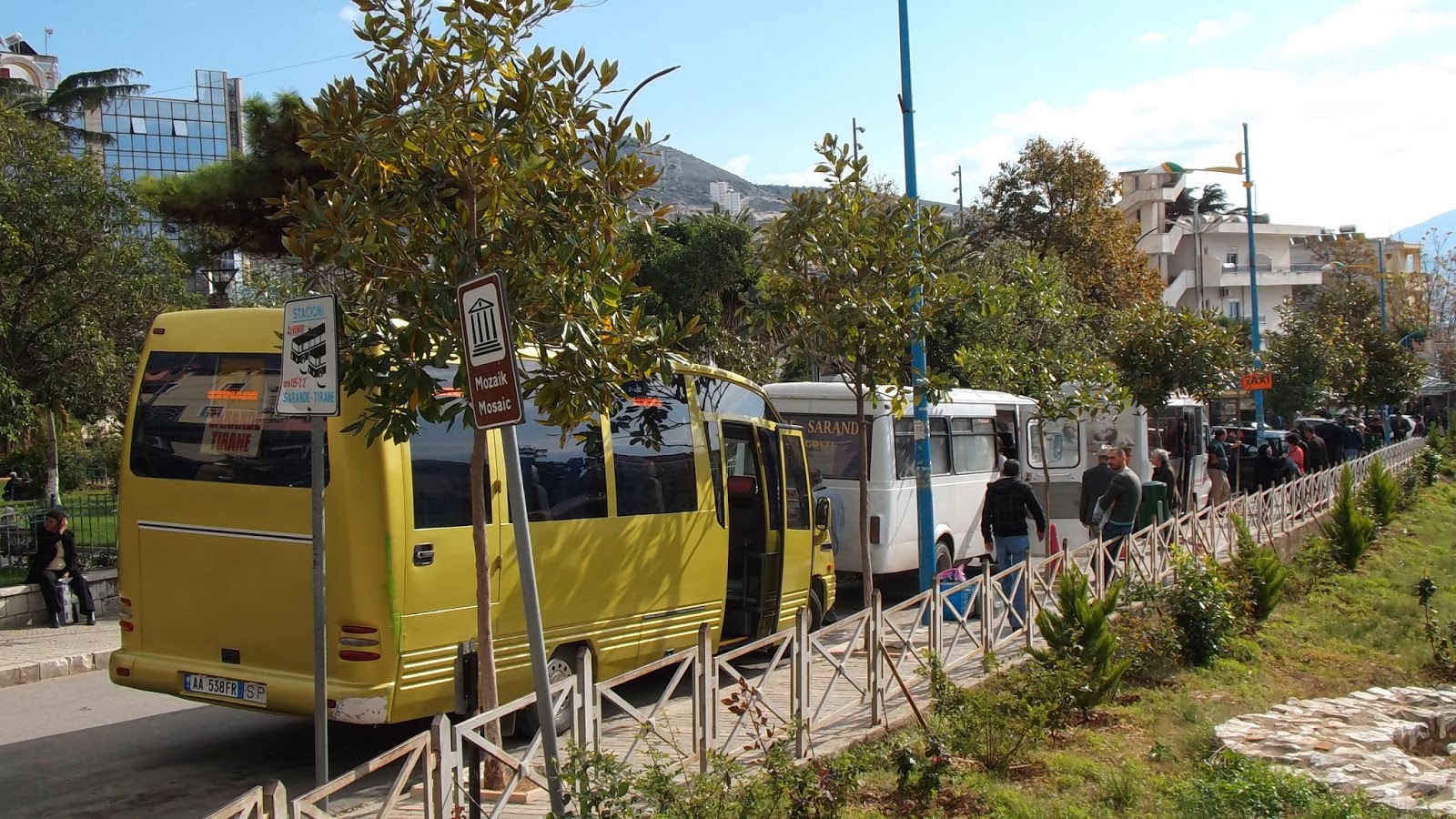

Buses and furgons waiting to leave from Saranda

Finally, because of the huge number of Albanians who live in Greece, many bus lines connect Albanian cities to Athens, Thessaloniki, Volos, Patras and other Greek cities daily. Bicycles are admitted on these buses, as experienced by a couple of cycle travellers I met on the road.


MONTENEGRO

The website lists all the daily local and international trains that travel across this tiny country.
The line Bar – Belgrade, which takes about 8 hours, is described as one of the most panoramic European railways, especially in the Montenegrin stretch that runs along Lake Skadar and then crosses the Dinaric Alps.

Buses connect the towns along the coast with each other and with the major cities in the surroundings (Dubrovnik, Mostar, Sarajevo).


BOSNIA AND HERZEGOVINA

The website lists all the local and international trains that travel across Bosnia-Herzegovina. Sarajevo is connected to Zagreb (via Banja Luka) and to Ploče, on the Adriatic Sea (via Mostar). The ticket for the train Sarajevo – Mostar (very beautiful mountainous landscapes) costs 9,90 Bosnian marks (5 €) and the additional fare for the bike costs 7 KM (3,50 €).


Sarajevo – Mostar on a Swedish train of the 1960s...
Very comfortable seats and huge space for the legs!


Countries I didn't consider in this guide: Macedonia and Kosovo.

Overall, when coming to plan a bike journey through the Balkans, the option of combining biking with public transportation should be considered: this choice can allow you to visit more places and/or skip some climbs, travelling cheap and in a sustainable way.

Even though the cycling infrastructures cannot be compared to Central Europe, the Balkans have much to offer to those who wish to explore this region, admire its naturalistic beauty and know more about the history and the culture of its peoples.

9 January 2014

The moral duty of a traveller

I read some interesting thoughts about travelling and education on the Out of Eden Walk's blog. I already talked about this project a few weeks ago on this post.
Here is my take about travelling, education and how the two things are related.

Besides posting nice pictures, giving tips on places to see and writing how cool travelling is, I deeply believe that travellers have a very important task and a moral duty.

Even though it's easier than what most people think, travelling is not for everyone, because of possibilities, attitudes, personal problems and other impediments. For this reason, travellers are lucky to be able to live some experiences (unforgettable meetings, discovery of new cultures, breathtaking views, etc.) that are precluded to those who cannot travel. Travelling means learning, extending one's knowledge, making connections, widening perspectives and, at the end, developing a global consciousness.

We are lucky enough to have technologies that allow people to spread information as never before. While sharing travelling stories through a screen doesn't give the same emotions as going on a real journey, it can surely inspire other people. The least a traveller can do is saying "look, the real world is different than what you might imagine, there's a lot to discover out there, the people we call foreigners are not as bad as they make us think, go check it out yourself if you can". In this way, the traveller's individual growth is extended to the society around him.

In my opinion, travelling and education are strongly connected.
Go, learn, understand, share: that's the moral duty of a traveller.
A hundred times a day I remind myself that my inner and outer life depend on the labors of other men, living and dead, and that I must exert myself in order to give in the measure as I have received and am still receiving. (Albert Einstein)

7 January 2014

News

La Tribuna di Treviso, a local newspaper, published an article about A European Journey, written by Annamaria Serena. Here it is:


Additionally, on January 16 I'm going to talk about my experience in Staranzano (Gorizia), during a series of nights about cycle travelling organized by the association FIAB - Bisiachinbici. Here's the event, if you happen to be around that area at that time:


Going back to the real deal: don't worry, I'll be back on the road pretty soon, probably in the first half of February!

Stay tuned on Facebook and Twitter!

18 December 2013

Migration: Paul Salopek's Out of Eden Walk

December 18 is International Migrants Day.

Migrations have frequently occurred in the recent history of mankind, almost everywhere around the world. Now, since the world is becoming smaller and smaller, the migration routes are becoming big highways: today more than 200 million people are migrants, according to the data of the United Nations.

Yet, migration is far from being considered a normal phenomenon, especially when it comes to seeing foreigners arrive in our own country. Immigration and emigration have changed the history of many European countries, with some dramatic cases standing out: around half of the Albanians live away from their countries of origin (Albania and Kosovo).
Millions of Europeans left in search of a better life in North and South America, and it's been only after World War II that Europe has started receiving a considerable amount of immigrants.

But... Where did it all begin? Africa, Rift Valley. After wandering around the Continent for a while, our common ancestors decided to walk around the globe and set foot on most of the lands of this planet.

Now, in 2013, the journalist Paul Salopek (read biography here) has decided to walk on the pathways of the humans who first colonized the world: he started an awesome, mind-blowing 7-year journey by foot, beautifully documented in his project called Out of Eden Walk.

Give a look to the website and to the related contents: simply amazing!
"The guiding star of the walk’s storyline isn’t me. It’s the journey itself, the swarm of ideas and people encountered along the road. The opportunities to link the ambulatory journalism to education are nearly limitless." (Paul Salopek)


Out of Eden Walk Trailer from Out of Eden Walk on Vimeo.

13 December 2013

European toponymy* and synecdoches**

* Toponymy: "the study of place names"
** Synecdoche: "a figure of speech in which a part is made to represent the whole or vice versa [...]"

The following post wants to address an important issue, because, as Chris McCandless said, it is important "to call each thing by its right name". As Mandela said, it is also important not to randomly quote famous people, but that's another issue.

"Bosnia"

Level 1: Bosnia is a geographical region, but it is not a country. Bosnia and Herzegovina IS a country. Herzegovina is also a region. The region of Bosnia and the region of Herzegovina together form (guess what?) Bosnia and Herzegovina.
Level 2: People from Bosnia are called Bosnians. People from Herzegovina are called Herzegovinians. People from Bosnia and Herzegovina are generally called Bosnians, even though if you say "Bosnian" to a person from Mostar you might be corrected to "Herzegovinian".
Level 3: Bosnia and Herzegovina (abbreviation: BiH) is divided into 2 entities, Republika Srpska and Federation of Bosnia and Herzegovina (or simply "Federation"). Republika Srpska of course IS NOT the Republic of Serbia (which is the formal name for Serbia, by the way). Federation of Bosnia and Herzegovina obviously IS NOT Bosnia and Herzegovina, just one of its two parts.
Level 4: The official capital of Republika Srpska is Sarajevo, but the National Assembly and the Government are based in Banja Luka. The capital of the Federation is also Sarajevo. The capital of Bosnia and Herzegovina is... (drum beats) ...Sarajevo!
Level 5: In Bosnia and Herzegovina there are 3 "ethnic groups", which mostly reflect the religious affiliation of the Bosnians: Bosniaks (= Bosnian Muslims), Croats (Catholic) and Serbs (Orthodox). Republika Srpska has a majority of Serbs, the Federation has a majority of Bosniaks, although some cities (especially in Herzegovina) have a Croat majority.
Level 6: Bosnian Croats are Croats (of course!). Croatians are also Croats. If I understood correctly (it's level 6, guys!), a Croatian is a citizen of Croatia; "Croats", on the other hand, defines the "ethnic group". But in Italian, Croatian and Croat are both translated with "croati"...

"Macedonia"

- The Republic of Macedonia is the formal name of the country that is called Macedonia by most people in the world.
- Macedonia is also a region of Greece. Its biggest city is Thessaloniki.
- Macedonia is also an historical region which includes Macedonia (region of Greece), the Republic of Macedonia, and parts of surrounding countries.
- The Republic of Macedonia IS NOT called Macedonia by the Greek people. Instead, it is called "Former Yugoslavian Republic Of Macedonia" (FYROM).


Last but not least, macedonia is the common word used in Italy to indicate the fruit salad...

"Holland"

HOLLANDE IS NOT A COUNTRY! (caps lock required...)
This funny video explains the whole deal:


"England"

Although this blog specifically deals with Europe, this is als... What? Oh yes, "England" is actually a part of Europe, they told me.


"Friuli"

Andate a Trieste e rivolgetevi ad un triestino chiamandolo "furlan". E capirete.

10 December 2013

One important thing and many boring statistics

Important thing

This is something I wrote a few months ago, after I started hosting and meeting people through Couchsurfing and Warmshowers in Coimbra. After 2 months playing the part of the "surfer", it got an even greater meaning:
[...] maybe the greatest life lesson has come from couchsurfing. We are often warned about how dangerous the world is and how wrong it is to trust a stranger. But we forget that we are strangers in the eyes of every traveller and that our behaviour can influence his/her opinion about our own town, our country or even the goodness of mankind. By defeating fear and prejudice towards other people, we are always rewarded with some good moments which remind us that, after all, "there is some good in this world, and it's worth fighting for". Stay human.
Thanks to all the "strangers" that turned into friends!


Boring statistics

64 days.
63 nights in 43 different places.
44 nights hosted by someone, 17 nights in hostels/rooms, 2 nights on overnight trains.

18 borders crossed.
11 countries.
7 capitals: Ljubljana, Zagreb, Belgrade, Sofia, Athens, Tirana and Sarajevo.

2580 km by bike.
2500-3000 km by train or bus.
135 km on the longest biking day (November 18, from Parga to Sarande).

16 trains.
4 buses.
1 ferryboat.
1 bicycle.

15 km/h: normal average on a hilly day for the first week, when I was out of shape.
18 km/h: normal average on a hilly day after 1 month.
8 km/h: reasonable speed on a 6-8% climb.
58 km/h: maximum speed.

33x16, 33x18, 33x20: most used gears (= 3,5-4,5 metres per pedal revolution).
10^5 - 10^6: order of magnitude for the number of pedal revolutions during the journey.

75 kg: my weight.
~ 18-20 kg: total weight of the bags.
~ 15 kg: weight of the bicycle.

Max temperature: 28°C, 4/11/2013 in Thessaly, Greece
Min temperature: -3°C, 29/11/2013 in Sarajevo, Bosnia and Herzegovina (not biking though...)

1 puncture.
0 other significant problems with the bicycle.

~ 850 € spent during the journey, of which:
230 € on accomodation
200 € on transportation
30-40 € on museum entrances and other tickets
20 € on the bicycle
almost all the rest on food/drinks (5-6 € per day)

Countries for number of visits in the blog: Italy (3000), Croatia (1100), USA (300), Greece, New Zealand, Brazil, Germany, France, Spain, Slovenia, Portugal...

0 kg lost while travelling.
100-120 g: average quantity of chocolate I ate everyday.
3 damn good tiramisù made.


9 December 2013

Borders

"Mitakuye Oyasin" is a Lakota prayer. It means "we are all related" or "all my connections".
We are all related, so there is no difference among people, so need for borders. "Imagine there's no country...", using more famous words. I don't know if it is just a coincidence, but I immediately thought at where the Lakota people live: in the never-ending Great Plains. How can you imagine setting a border in a place like that?

64 days travelling through the Balkans, 18 borders crossed:
1) Italy-Slovenia
2) Slovenia-Croatia
3) Croatia-Hungary
4) Hungary-Croatia
5) Croatia-Serbia
6) Serbia-Bulgaria
7) Bulgaria-Greece
8) Greece-Macedonia
9) Macedonia-Greece
10) Greece-Albania
11) Albania-Montenegro
12) Montenegro-Croatia
13) Croatia-Bosnia and Herzegovina
14) Bosnia and Herzegovina-Croatia
15) Croatia-Bosnia and Herzegovina
16) Bosnia and Herzegovina-Croatia
17) Croatia-Slovenia
18) Slovenia-Italy


Many people asked me how it is to cross a border on a bicycle. The answer is: nothing special. The first time is fun, then it becomes just a matter of showing your ID (Italian citizens don't need passport for any country that I visited, even for those that don't belong to the EU) twice to the Police of both countries on the border. They might ask you where you are going, and nothing more.

A lot of blood was spilled to determine whether a certain border should be in the place it is or a few kilometres away. Borders changed the lives of many people: am I part of a majority or minority? Was I born in the "wrong" place? Lakota people would not understand this, I bet.

Questions:
1) Why do borders exist?
2) Are borders immutable?

While borders have a certain political and administrative function, I think it is everybody's task to question their existence, at least on a "thesis, antithesis, synthesis" base. Thinking that the current borders have always existed, have historical legitimacy and therefore will always exist is just useful propaganda, most of the times. In fact, borders don't exist, if you try to convince yourself of it.

It seems common to all countries to declare their current borders immutable to prevent parts of their territory to secede and declare independence. For example, Article 5 of the Italian Constitution states: "The Republic, one and indivisible, [...]". The United States of America also don't give the right to secede peacefully to parts of its territory, although the 1776 Declaration of Independence would suggest the opposite, when saying that "[...] whenever any Form of Government becomes destructive of these ends, it is the Right of the People to alter or to abolish it, and to institute new Government, laying its foundation on such principles and organizing its powers in such form, as to them shall seem most likely to effect their Safety and Happiness".

Without aiming at writing a political essay, I just wanted to introduce the topic because I feel that there is too much nationalist crap everywhere in the Balkans (and not only there...). I'm saying it straight just because I started loving the history, the culture and the people who live in this area, and when you love a place you try to understand its past and care about its future.

For nationalists, borders separate "us" from "them". Even though those borders changed several times in the past 100 years, now they can't change anymore, they say. Tradition, culture and language of the homeland must be preserved, apparently.

But seriously, how can people (not politicians, who do it just for their own interest) give so much importance to these fictitious lines?
Any Serb will find happiness when the last Bosniak leaves Republika Srpska?
Any Croatian will find happiness when Vukovar becomes a cyrillic-free city?

Mitakuye oyasin.

31 October 2013

Counter migration: from a big city to a little village

On my first night in Greece I was hosted by Stelios, who lives in Odigitria, a little village with 30 inhabitants.

Stelios's story is an interesting one: he was born and raised in Athens (population: 4 million people). After working for 3 different companies, 5 years ago he lost his job with Vodafone. He was 35 years old and he had a higher salary than the young people they were probably going to employ on his place (ethical company, isn't it?). Tired of the city life, which he never really appreciated, he decided to dramatically change his life and move back to the village from which his grandparents emigrated many years before. A little at a time he renovated his family's old house, which had been abandoned for 20 years, he got a dog and he started growing vegetables in the garden.


Then the economic crisis hit Greece, changing the life of many people. Now Stelios has a couple of temporary jobs, but he doesn't have a regular one. However, besides the current difficulties, Stelios would never move back to Athens: in Odigitria he found priceless things that he would never exchange with his past chaotic life: following the natural rhythm of the day, listening to the sound of the breeze that blows through the leaves, having an afternoon walk with his dog on the nearby hills right before sunset... He is not even "excluded" from the rest of the world, using Internet for communicating, reading news, hosting people with Couchsurfing and buying most of the things he needs.

Yes, he would like to have some money to travel as he used to do some years ago with his motorcycle. Yes, he wishes the government didn't put such high taxes on his old house. But, on the other hand, Stelios entirely owns his life and his time. How many people can say the same?

The story of Stelios is an interesting starting point to share some thoughts and open a discussion about city life vs rural life: everywhere in the world the migration pattern goes from villages to cities. People leave their native places to go to the cities to study or work. They end up never going back to their hometown, mainly because of opportunities: the city is a magnet which inevitably attracts the "metallic" materialistic part of us (basic needs like money and food, but also "luxuries"). Our dreaming part loses power, but never disappeares, because most city people still dream about exotic deserted beaches, mountain villages and huts, rural heavens, where they usually spend relaxing holidays. Yet, if rural or even "intermediate" areas could offer the same working and social opportunities of the cities, they would not hesitate to move there.

Now, the point is: 2013, Internet, e-commerce. Could it be an opportunity for a new and different development of rural areas? Little villages have been associated with poverty, agriculture, bad education, while cities have been praised for their industry, opportunites, education. Does this make sense in the Information Age? Can the mountain villages in the Alps and the fishing villages of Portugal pursue a new model of development?


Last but not least: the human factor. More people often equals more conformity and less self-discovery. Take Milan, London, Zagreb, Belgrade, Sofia. The cities are different, but people do the same things everywhere. It's unbelievable, if you think at it.
Take Pierre (South Dakota, USA), Cornuda (Veneto, Italy), Mala Subotica (Međimurje, Croatia), Odigitria (Central Macedonia, Greece). These places are unique. There lies the heart and the culture of a country.

22 October 2013

Biking through recent History

I had read some things about the Yugoslav Wars before the begin of this trip. After seeing the places with my eyes and hearing stories from people who were actually there in the years of the war, I'll try to write a few impressions about this topic with regard to Croatia and Serbia. If the journey goes as planned, I might visit Bosnian cities of Mostar and Sarajevo on my way back.

(It's not an "easy" topic, so any comment/correction is welcome, as always)

  • Vukovar:
    I must start from here. This city is the symbol of the Serbian-Croatian war. I've been told that it was one of the richest city in former Yugoslavia. You might agree that it's true just by looking at the many big factories and industrial buildings that you see if you arrive in the city from the west.
    Then, the war. The population, which was evenly distributed between Serbs and Croats (who had lived together peacefully until then), has dropped from 45.000 to 25.000: many Serbs moved to Novi Sad or Belgrade, many Croatians started a new life in Zagreb, far from bullet-marked houses, mined fields and an atmosphere which is still filled with hate and contrasts between the two ethnical groups. For example, Serb and Croatian kids are in separated classes at school until college. The events of the past are still too recent to be forgotten, the difference is about how people look at them: someone remembers and looks at the future, many other people remember with their heads turned back to the past.

  • Breaking news: my part in the history of Vukovar :)
    I arrived in Vukovar on October 17. On the same day the Prime Minister of Croatia, Mr. Zoran Milanovic, was in the city to talk to the nationalists and to the war veterans about the issue of cyrillic signs, which are to be installed because the Serb minority make up more than 1/3 of the total population of the city. High tension. In the previous days, 2-3 policemen of the special forces had to stand in front of every plaque written in cyrillic alphabet, because of people continuously trying to tear them down (big question: why?). So... this guy (me) who arrives on the bike seems an alien in this place at this time: is he a terrorist who hides a bunch of AK-47 in his panniers and aims at killing the PM? I don't know if they followed me or what, the fact is that the Police called Zoran, my Warmshowers host for the night, to make sure I was actually a normal traveller...
    Weird story, but it exemplifies well how the situation is around there.


  • My meetings
    A girl whose family escaped from the Croatian part of Baranya because of the war and then returned when it was over. A professor in Vukovar High School who was studying in Novi Sad during the war, having his family in the middle of the conflict. Now the big old house of some of his dead relatives has almost no value, since the city is still under reconstruction and has high unemployment and very little perspectives for the next future.

  • Yugoslavia and Tito: a compendium (trying to simplify complicated things)
    - Yugoslavia as known between 1945-1991 had never been a unique country in history, although some cultural traits are common to the people of the area. Parts of its territory were controlled until WW1 by Austria-Hungary and Ottoman Empire.
    - Croatians are mainly Catholic, Serbs are mainly Orthodox. In Bosnia and Kosovo there are big percentages of Muslims as well.
    - 1941-1945: Yugoslavia is occupied by the Nazis and other Axis countries. In Croatia there is a satellite fascist government (Ustaša), responsible for killing many Serbs.
    - 1945: Partisans led by Tito send away the occupants. It's the only European country which is not freed by the Allies, thus allowing it to take a Non-Aligned position and a certain independence from the Soviet block in the Cold War. Yugoslavia is organized as a federation, in which the regions are more or less those that now have become independent countries.
    - 1970s: Despite economic difficulties and rising requests for more independence from what has always been considered a Serb-centric nation (see Great Serbia), the country remains in peace until Tito's death in 1980. Tito was a dictator, but he represented at the eyes of most of the population a positive hero and a common symbol of anti-fascism.
    - 1980s: Changed economic balance in Europe (due to USSR's collapse), loosened grip of central government on peripherical regions, contemporary growth of nationalisms in Slovenia, Croatia and Kosovo.
    - 1990s: Breakup of Yugoslavian Communist Party. Referendum on independence in Slovenia, Macedonia, Croatia, Bosnia. The former 2 states obtain independence "easily", Croatia and Bosnia fight for it until 1995, when NATO intervention put an end to the conflict.
    In 1999 other NATO intervention in support of Kosovo Albanians against Serbia.
    - 2000s: Montenegro and Kosovo form independent states.

  • Consequences of the above:
    - Presence of nostalgia of Tito.
    - Serbians feel "victims" of US and Western European interests in the area (mainly regarding Kosovo, which they don't recognize as a country): good reason to "use" to raise Serbian pride, nationalism, etc.
    - Relationships among countries and among different ethnic groups in the same country are far from being stable (excluding Slovenia).
    - These problems stop Serbia from entering the EU. Macedonia has quarrels with Greece and Bulgaria as well.

  • As said by a disilluded Serbian guy at the hostel in Belgrade:
    "There are 2 political parties: one of them is the party of the football hooligans (of every team) and of the nationalist idiots, which are often the same thing; the other one is the party of the people with a little bit of brain, but it's mostly made up by idiots anyway."

5 October 2013

The beginning

Today, October 5, A European Journey has started. A few things I'd like to write at the beginning:


Me

A couple of interviews were published: they talk a little bit about the project and about me.
You can find them on the websites of Life in Travel and Bicycle TV.

In my plans, I'm not going to write very much about the biking part of the journey: there are plenty of blogs in the net where you can read a diary of every single day of someone's journey, but IMHO they are quite boring most of the times. At least, mine would be a boring one. So, no everyday update about n° of kms, averages, where I stop to eat, time I start and finish biking, etc. :)
I'll update Facebook and Twitter as often as possible with pictures.

Instead, I'm gonna try to tell stories about the people, the places and the things that impressed me, keeping a subjective view of things.
In most books, the I, or first person, is omitted; in this it will be retained; that, in respect to egotism, is the main difference. We commonly do not remember that it is, after all, always the first person that is speaking. I should not talk so much about myself if there were anybody else whom I knew as well. Unfortunately, I am confined to this theme by the narrowness of my experience.
(Henry David Thoreau, Walden)

You

What about YOU? Since this is all about Europe, if you have something cool to say about Europe, you can share it with everybody. I hope to get a few contributions from Couchsurfing friends, but also from any reader: I greatly appreciate and welcome things like "you have to listen to this amazing progressive rock band from Montenegro!", "let me tell you why you should visit Poland" or "I explain to you why this geopolitical situation was created after the Yugoslav wars"!
This is the purpose of the journey: VISIT. LEARN. SHARE. UNDERSTAND.
Europe gives us tons of topics to talk about, most of them unknown to me. You're right, it's not necessary to ride a bike to do that, but I'm a self-defeating person, so that's how I do it. I love cycling, by the way.

Write me cool stories about the places I'm riding through, if you wish. Send to:
aeuropeanjourney@gmail.com


Couchsurfing

I talk to many people who don't even know that couchsurfing exists. Not good! Couchsurfing is awesome, seriously. This is what I wrote about couchsurfing (and similar projects, like Warmshowers) a few months ago, in a moment in which I was deeply inspired and in love with CS:
" Couchsurfing has taught me one of the greatest life lessons: we are often warned about how dangerous the world is and how wrong it is to trust a stranger. But we forget that we are strangers in the eyes of every traveller and that our behaviour can influence his/her opinion about our own town, our country or even the goodness of mankind. By defeating fear and prejudice towards other people, we are always rewarded with some good moments which remind us that, after all, "there is some good in this world, and it's worth fighting for". Stay human. "


Where I go

Here, more or less.


To family and friends

I often feel lucky because of you. This is a reminder I'll carry with me: